From Glasgow to Saturn Collage Poems

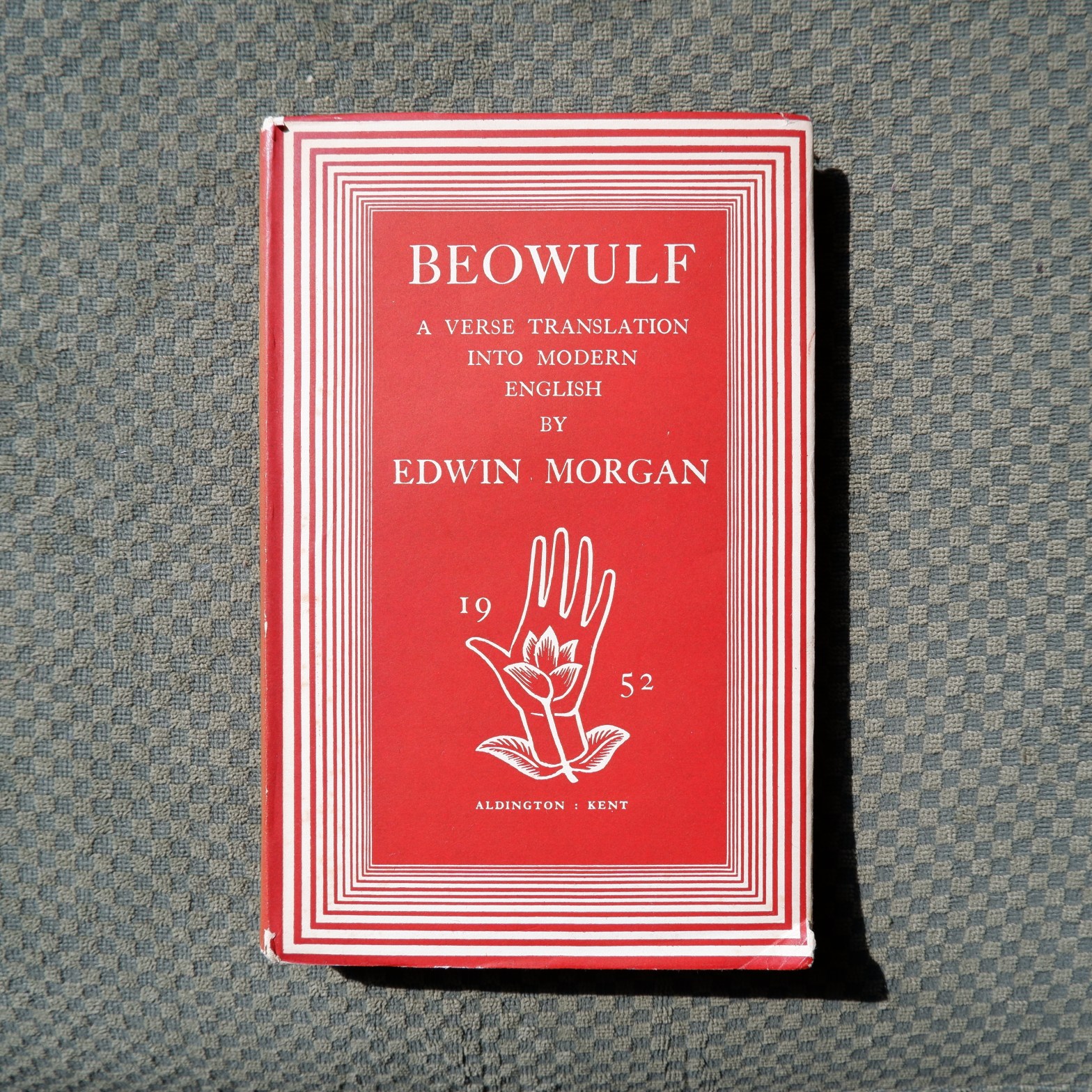
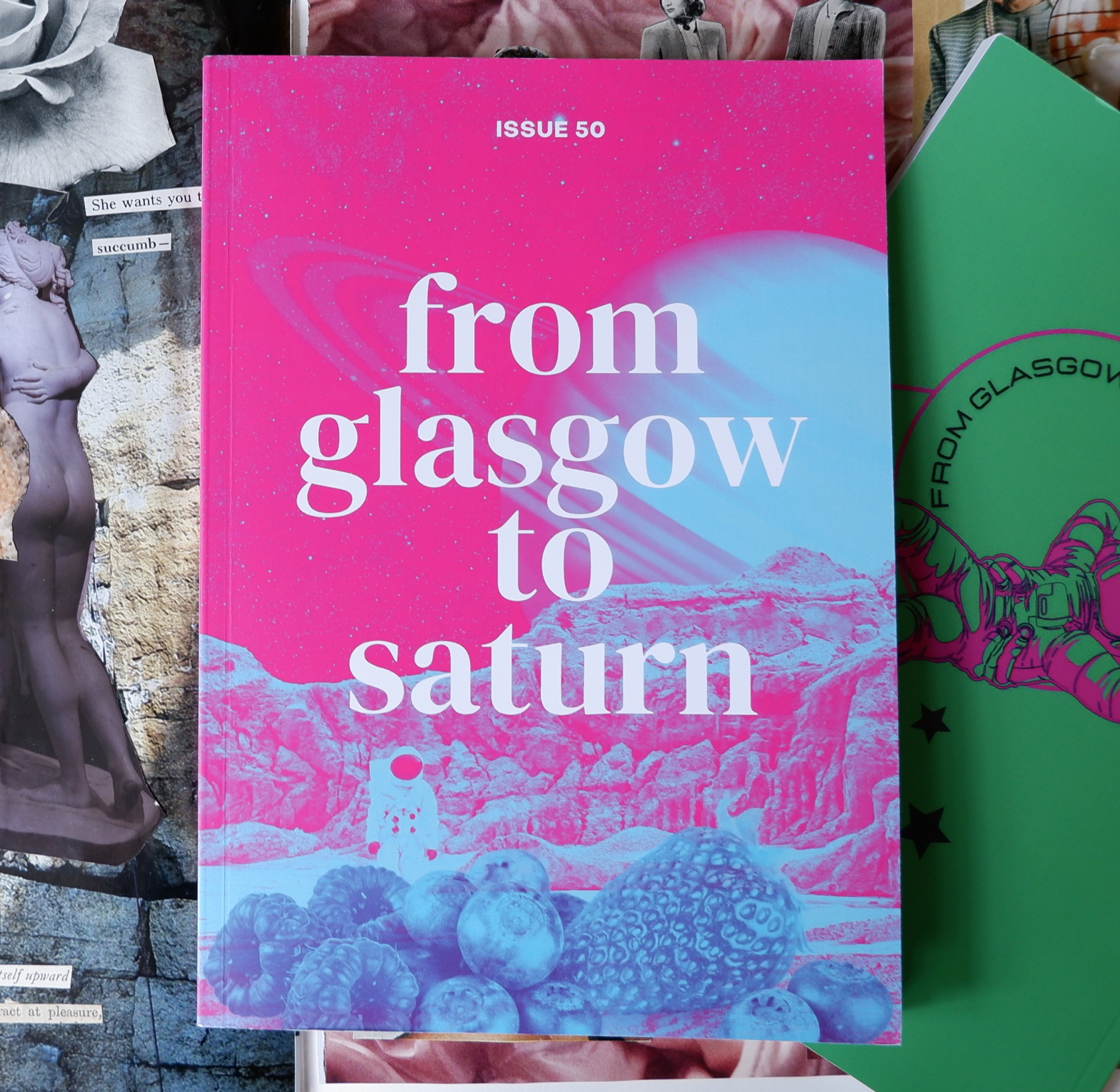
The 50th Anniversary issue of the Glasgow Journal From Glasgow to Saturn has a selection of collage poems by me in it. The journal takes its name from a 1976 poetry collection by Scottish Makar, poet and lecturer at the University of Glasgow, Edwin Morgan, and this edition is something of a tribute, or a response to him.
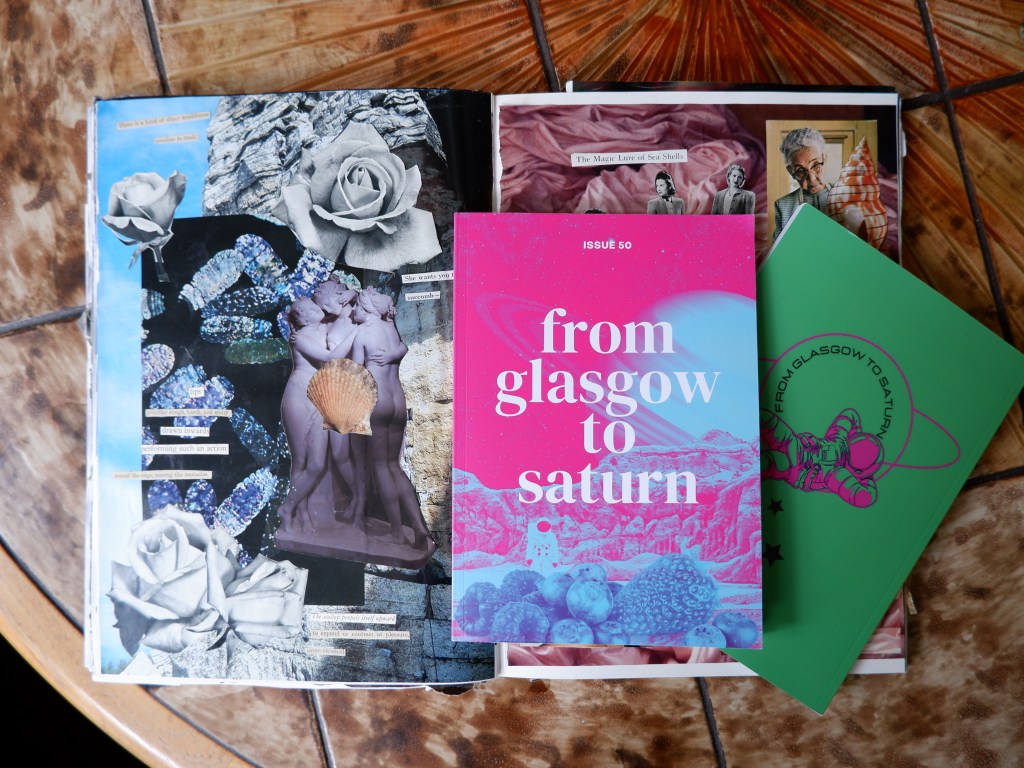
Picture shows copies of the journal ‘From Glasgow to Saturn’ laid over my sketchbook of collages and collage poems.

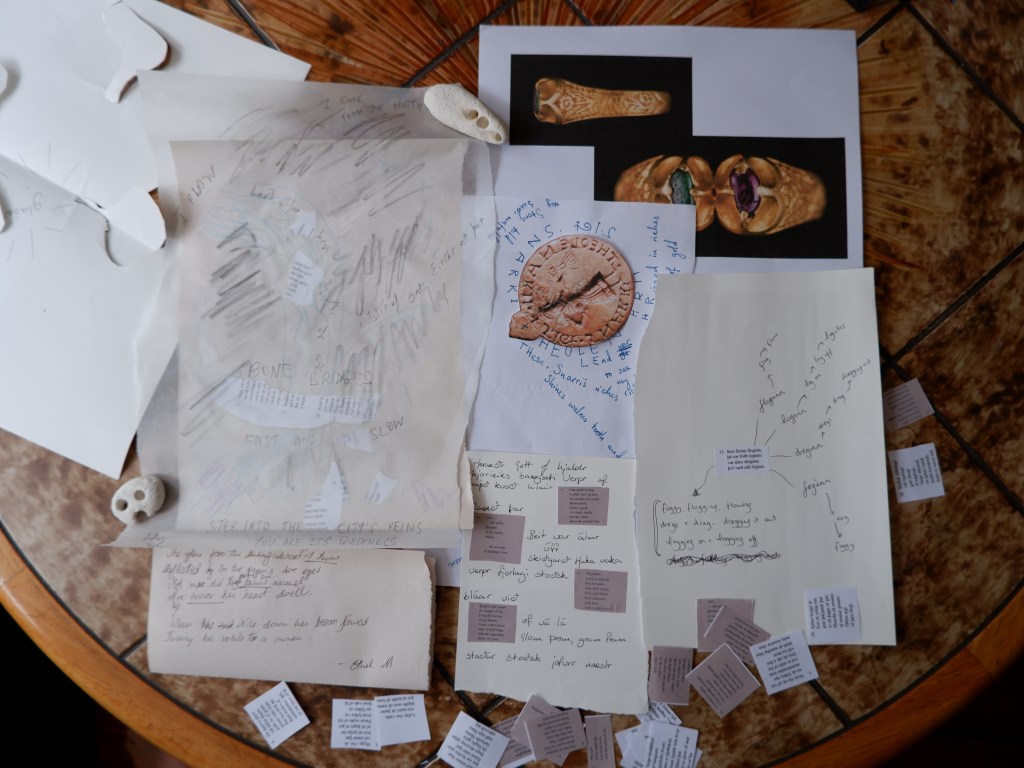
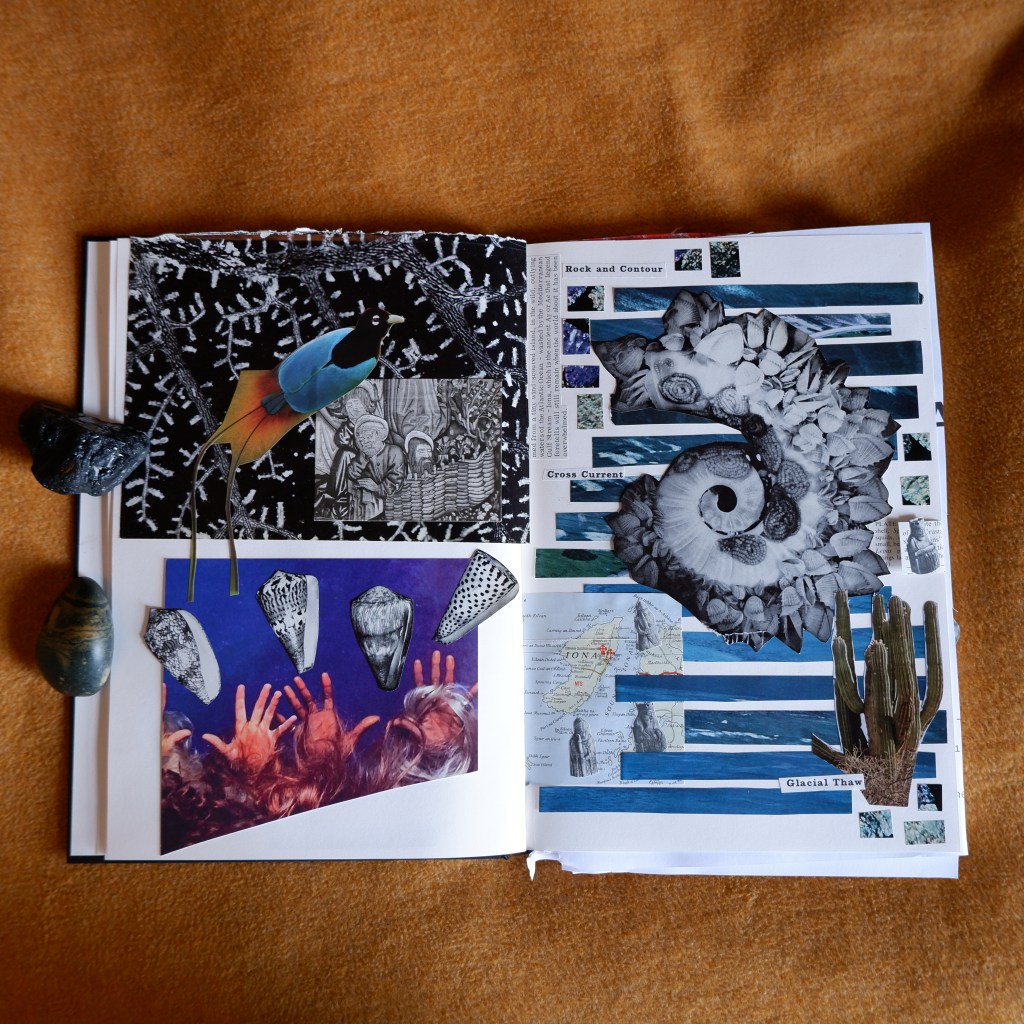
My poems for the journal – ‘Floating Curious’, ‘She wants you to glide’, and ‘Cliffs and Crags’ – are all ‘collage poems’, works of visual poetry that combine found text and imagery to create something new and surreal. I started creating collage poems during the pandemic, but it was really a research fellowship working with the scrapbooks of Edwin Morgan at the University of Glasgow Archives and Special Collections, that saw this method of poetic making flourish and develop.

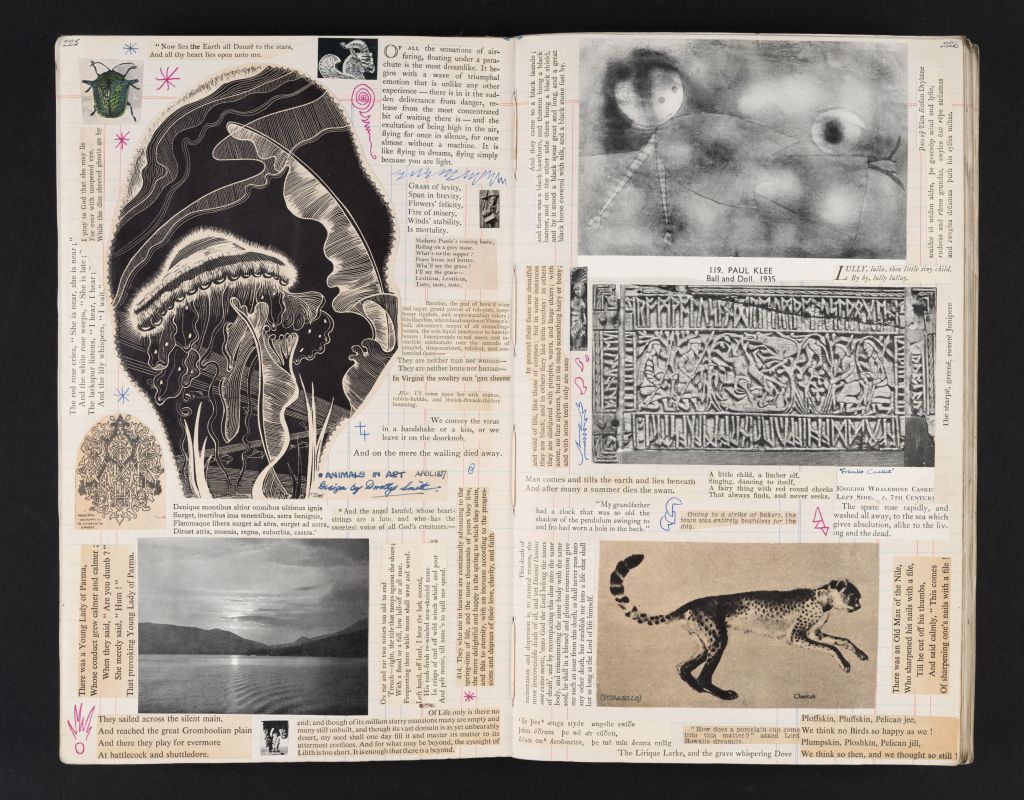
Morgan worked on his scrapbooks between 1931 and 1966. They are huge compendiums of literary quotations, found imagery, newspaper clippings, Morgan’s own drawings and dream journals; vast, tentacular maps of the poet and translator’s creative mind at work. It was a struggle to make sense of them as a researcher, but creatively poring over the pages had me fizzing to try out the process myself. I bought a hardbound sketchbook, a pair of scissors, and a stick of glue from Cass Art in the centre of Glasgow and started gathering printed materials with which I might create my own scrapbooks during the evenings of my fellowship.
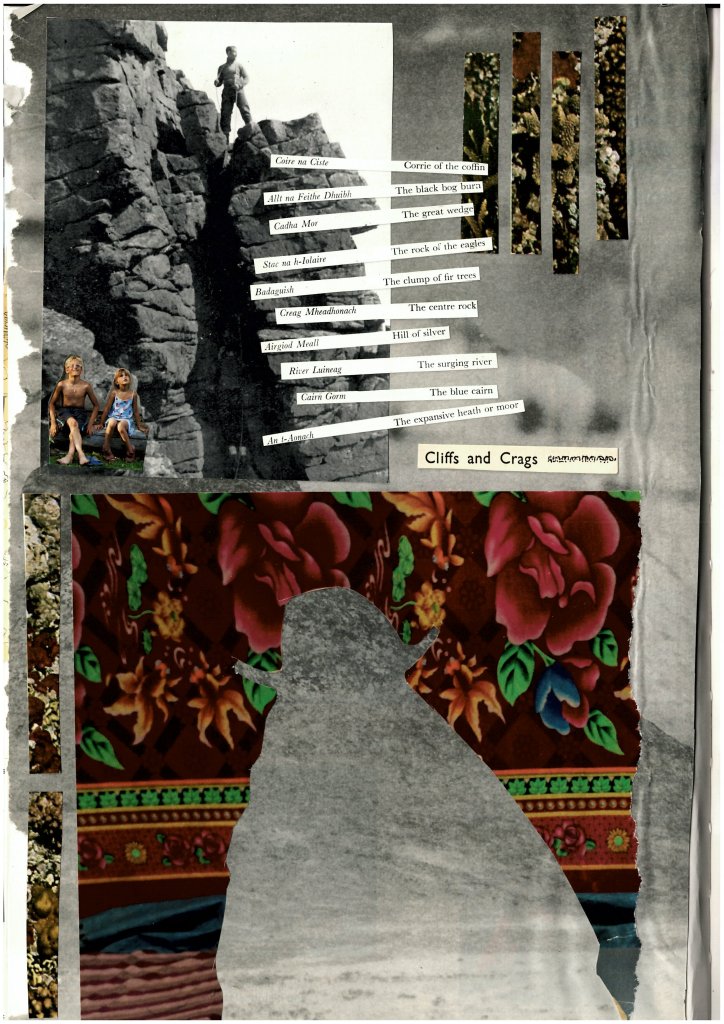
One of the collage poems, ‘Cliffs and Crag’s, published in From Glasgow to Saturn’. You will have to buy a copy of the journal to see the rest.

Working with Morgan’s scrapbooks has encouraged an interest in collage and visual poetry more broadly. I have been following 3am Magazine’s Poem Brut series, and really enjoyed reading Emma Filtness’s incredible collection The Venus Atmosphere, published by Steel Incisors (visual poetry press ‘with teeth’). One of my friends is also a wonderful collage artist and constant source of inspiration, Laura Mipsum, and in Manchester I have been to a Collage Club run by Local Hotel Parking, which introduced me to the joys of a good scalpel and cutting mat! I’m also grateful to Johanna Green, who not only welcomed me to Glasgow by introducing me to the delicious Little Italy Pizzeria but also encouraged me to think a bit more about visual poetry.

If there are any visual poets or collage artists you follow, I would love to hear about it in the comments below!

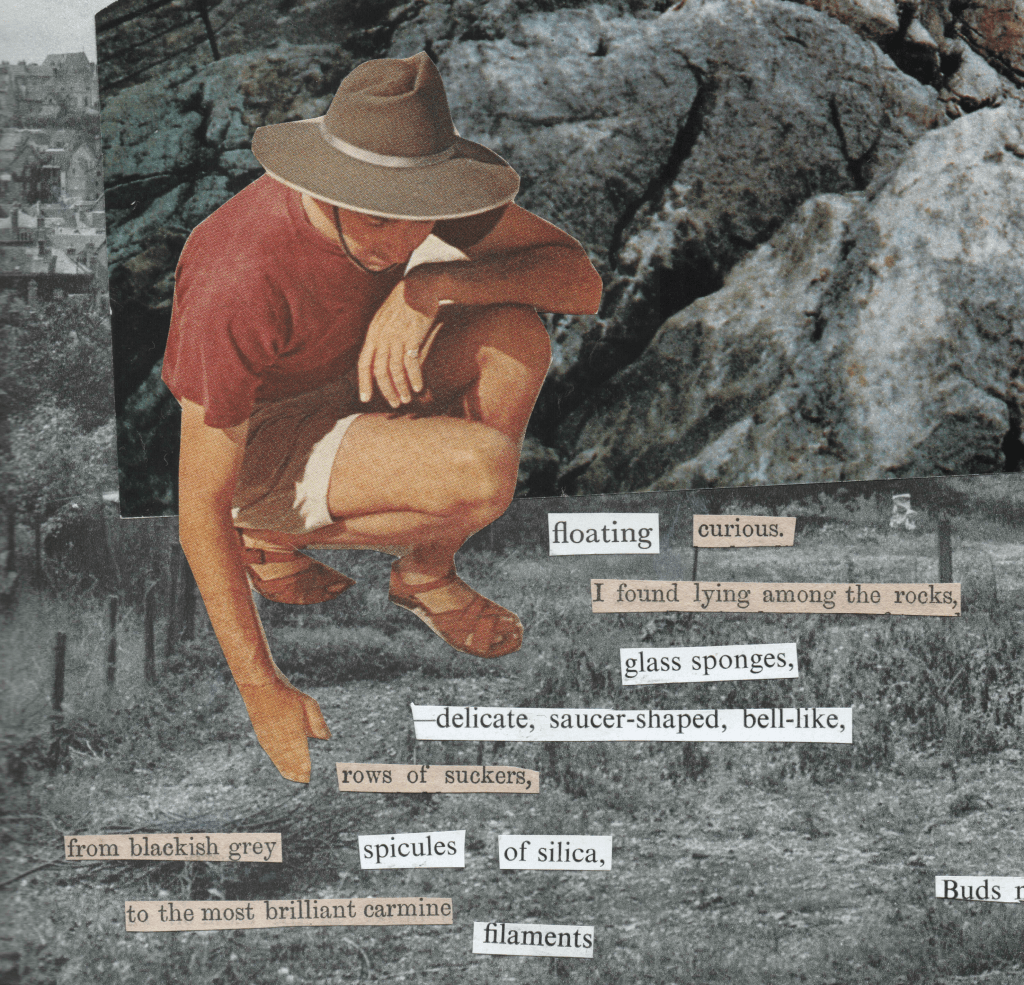
Close-up of some of the found text in ‘Floating Curious’

‘Choosing Jewels’ and the pleasures of searching for fungi

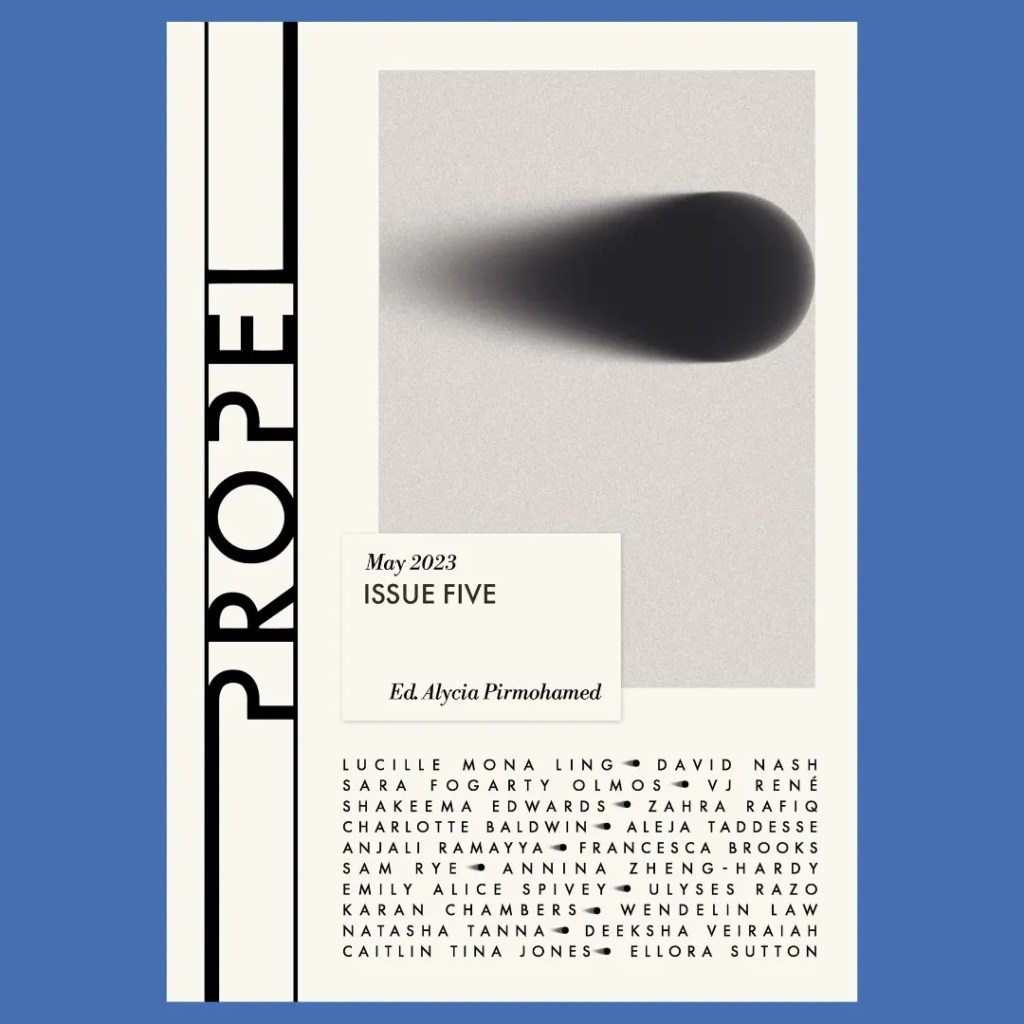
I’ve just had a poem published in the fifth issue of Propel Magazine, edited by the wonderful poet Alycia Pirmohamed (author of Another Way to Split Water). The magazine is available to read online for free. You can also listen to me and all of the other poets reading our work aloud and bringing the poetry to life.

My poem ‘Choosing Jewels’ is a love letter of sorts to the pleasures of searching for fungi. It takes its title from a phrase garnered magpie-like from the digitised manuscripts of Virginia Woolf’s To the Lighthouse, which you can explore here. I don’t want to say too much more about the poem here, as its spare and lyrical (I hope) and does its own work.

If you are curious about fungi too and would like to read more of my writing on the mycorrhizal world, I do have an essay about being landlocked and searching for mushrooms on The Clearing here.

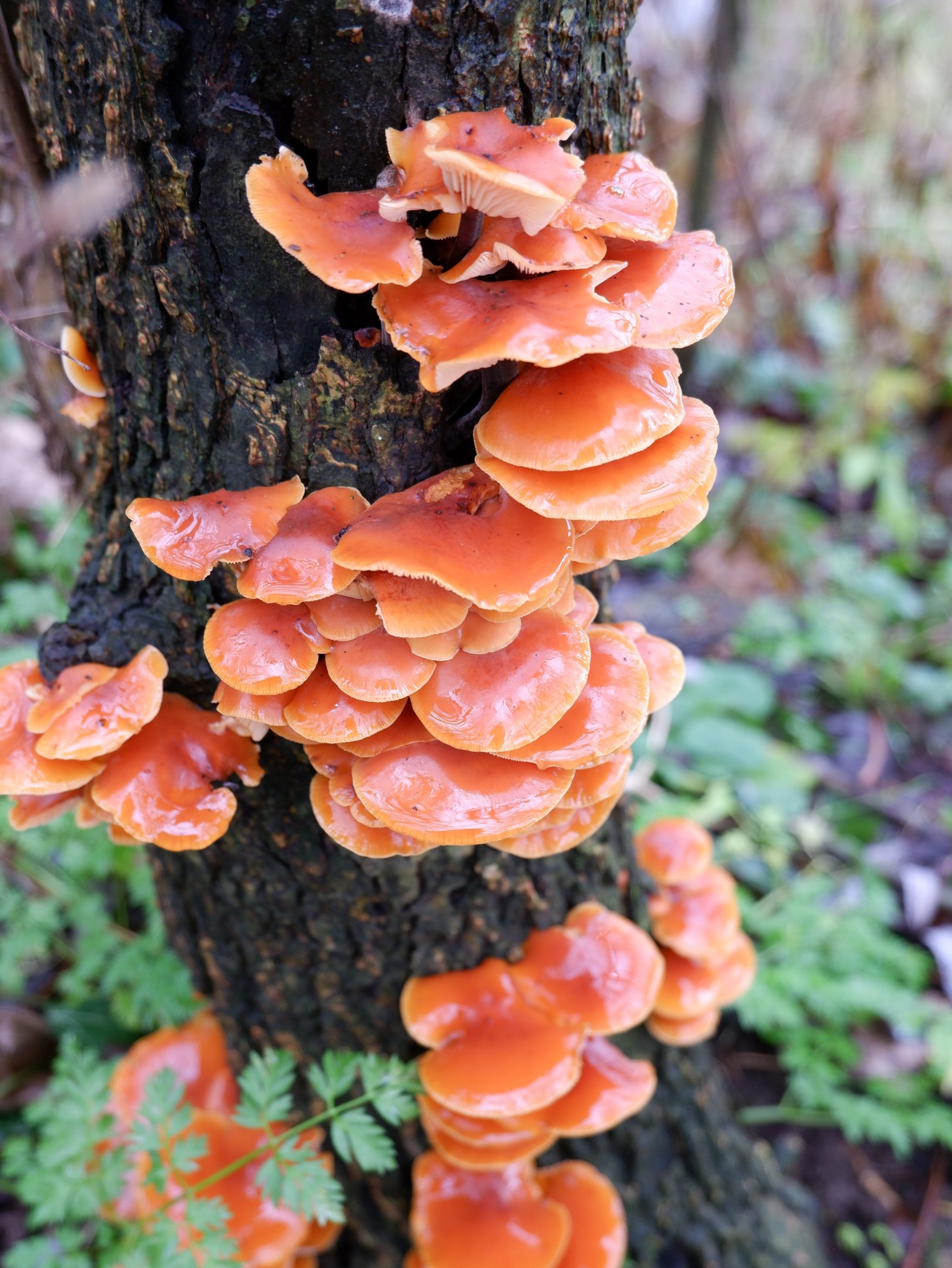
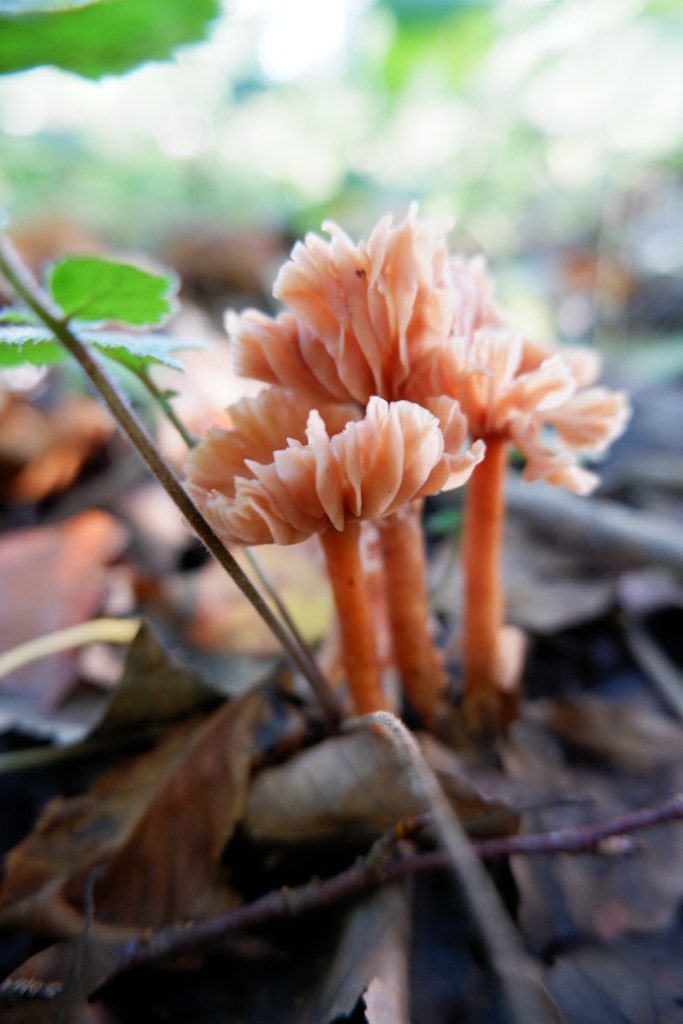
The pictures below show some mushrooms, or fungi, that aren’t at all shy about displaying the secrets of their gills.

Propel Magazine has a new guest editor for every issue and aims to showcase the work of poets who have not yet published a first collection. In her editorial Alycia writes beautifully about the work of editing as an opportunity not for ‘gatekeeping’, but for opening doors:

Anyway, all of this is to say I find being a gatekeeper a complicated thing, and though the job is to select only a few from the many, I hope that doors have also been opened: to new voices and strategies, to perspectives that are experimenting with subject and form. To poems that found a home here because they came across my particular gaze, and maybe I saw something, understood something, or felt something that the poet wanted to get across in a magical kind of symbiosis.

Alycia Pirmohamed, Propel Magazine Issue 5

I’m so grateful that my strange little mushroom poem caught Alycia’s eye.

Poet of the Medieval Modern: Winner of the University English Book Prize

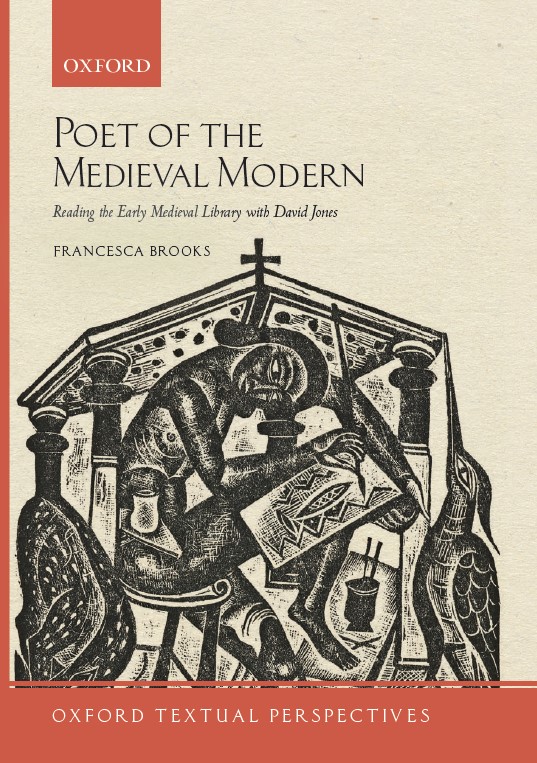
Poet of the Medieval Modern, my first monograph, has just won the University English Book Prize 2022! I’m really delighted to see the book receive this recognition and to see that the judges have understood so well what it was I wanted to achieve.

The judges write:

‘This is an exceptional book that combines a wealth and depth of scholarship with an engaging writing style that draws even the non-specialist reader in. Focussed on The Anathemata, a work published by Faber in 1952 by autodidact, artist, and poet David Jones, it demonstrates through meticulous examination of archival materials and annotations from the Anglo-Saxon Library as well as from previously unexamined correspondence, the extent to which acts of reading and creative critical thinking on Jones’s part underpinned production of The Anathemata, a culturally and linguistically composite text that uses translation as a means of cultural renewal.

It makes an original contribution to both Medieval Studies and Modernism, the former in respect of Jones’s engagement with Old English which Brooks shows to have had ‘a far greater influence … than previously recognized’ on his work, the latter in respect of the archival turn in New Modernist Studies. It combines archival research and genetic criticism with a nuanced understanding of creative process. […]

Uncovering a richly hybrid heritage that transcends national categories, this is an important book not just for modernist scholars in general but for anyone thinking about literary  identity.’

You can buy the paperback for just £18.99 from any online book retailer, but if you decide to buy direct from OUP here you can use the code ‘AAFLYG6’ to get 30% off.

The first review, written by Paul Robichaud for Modern Philology, can also be read here.

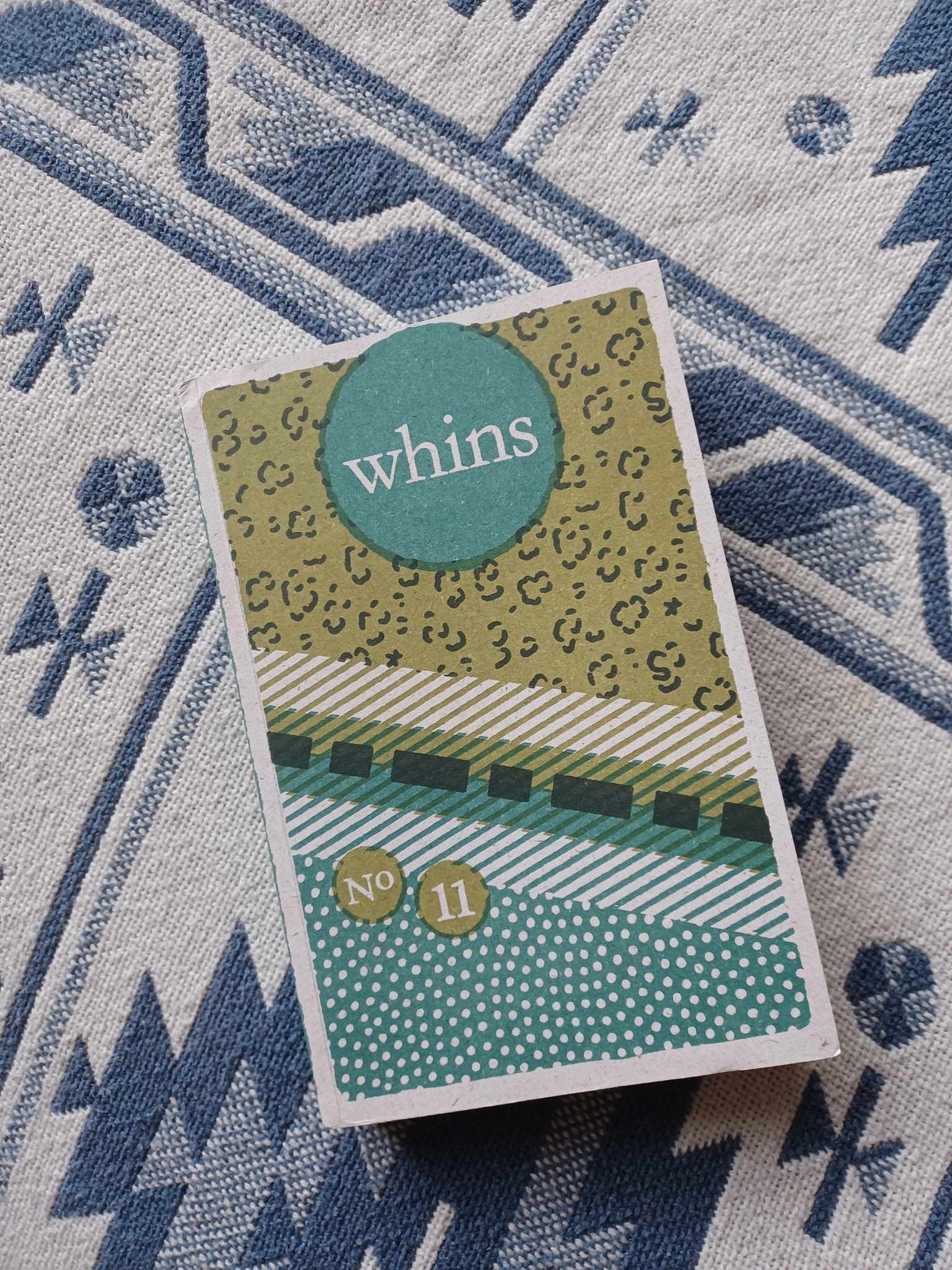
gorse 11: whins/furze…north/south

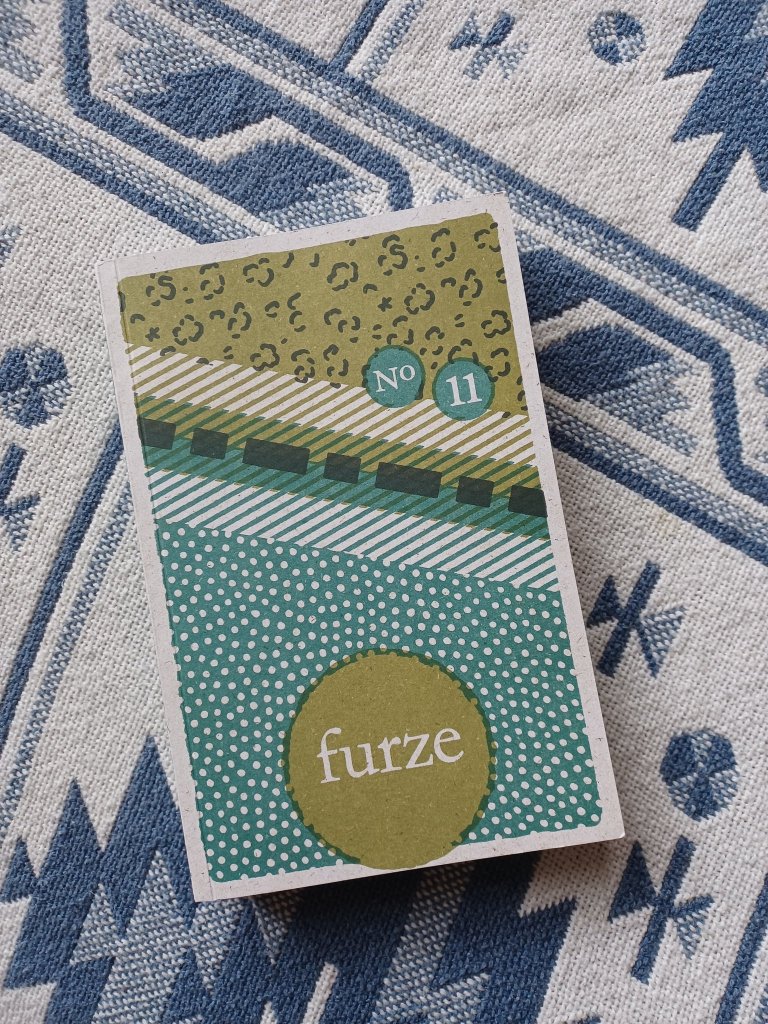
The long awaited eleventh issue of gorse just landed in my letterbox. The issue is a Têtebêche, or head-to-tail book, organised around the geographical poles of north (whins) and south (furze) and two of my poems appear in the southern realms of the issue: ‘Peckham Sketch #1’ and a long-ish sequence ‘Love and Sugar, after the military dictator’. It is beautifully designed. This explanation comes from the gorse website:

The cover shows a close up of a border division on a map, north of the line is Whins and south of the line is Furze. The two covers line up side by side to show a longer stretch of the border and they can also be arranged in an endless repeat of a divided landscape. A linguistic divide is much more ambiguous than a geo-political border, it suggests a much broader in-between and a gradual cultural blend rather than a definitive hard line.

Image shows the journal issue on the 'furze' side, laid out on a blanket

I submitted these poems and had them accepted for this issue around five years ago. I have been looking forward to seeing my work in print in this wonderful publication for a long time, but meeting these poems again after so long is also a little like reconnecting with a friend I had lost touch with.

‘She gathers them,

from among Ghana yams

and okra

as she passes a box of giant African land snails,

oozing cardboard on the pavement down Choumert Road.’

‘Peckham Sketch #1’, gorse 11

‘Peckham Sketch #1’ is a record of a walk down Peckham’s Rye Lane, and includes a loving little ode to the everyday wonder of Khan’s Bargains. The second poem, the sequence ‘Love and Sugar, after the military dictator’, is about learning a language in place, and the intimate and uncomfortable ways in which that language can become entangled with personal experience.

You can buy a copy of the issue from the gorse website here. It’s expensive, but also a thing of beauty with amazing contributions from Niven Govinden, SJ Fowler and Rike Scheffler, and Darran Anderson.

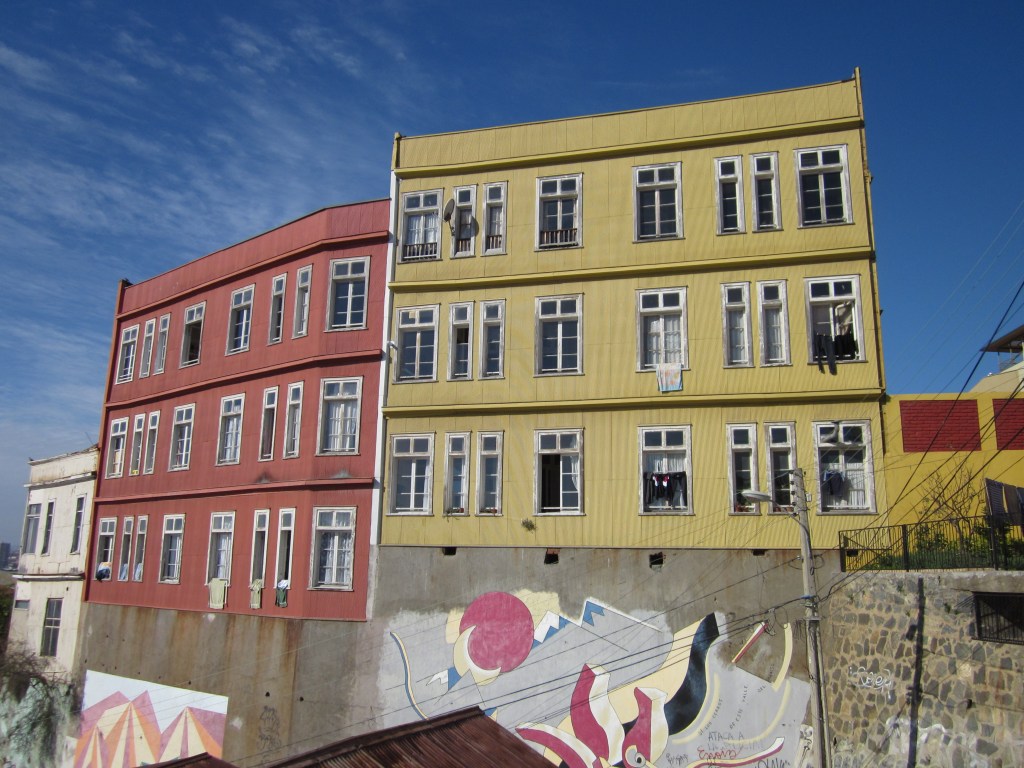
Picture shows a street in Valparaiso, Chile.
A street in Valparaiso, Chile

Scrapbooking Old English with Edwin Morgan

I spent March in Glasgow for a Research Fellowship with the Archives and Special Collections of the University Library, long delayed from 2020 because of the pandemic. I had been dreaming of Glasgow for a long time, often through the poetry of Scots Makar and Glasgow Laureate Edwin Morgan, whose archive my fellowship research was focused on.

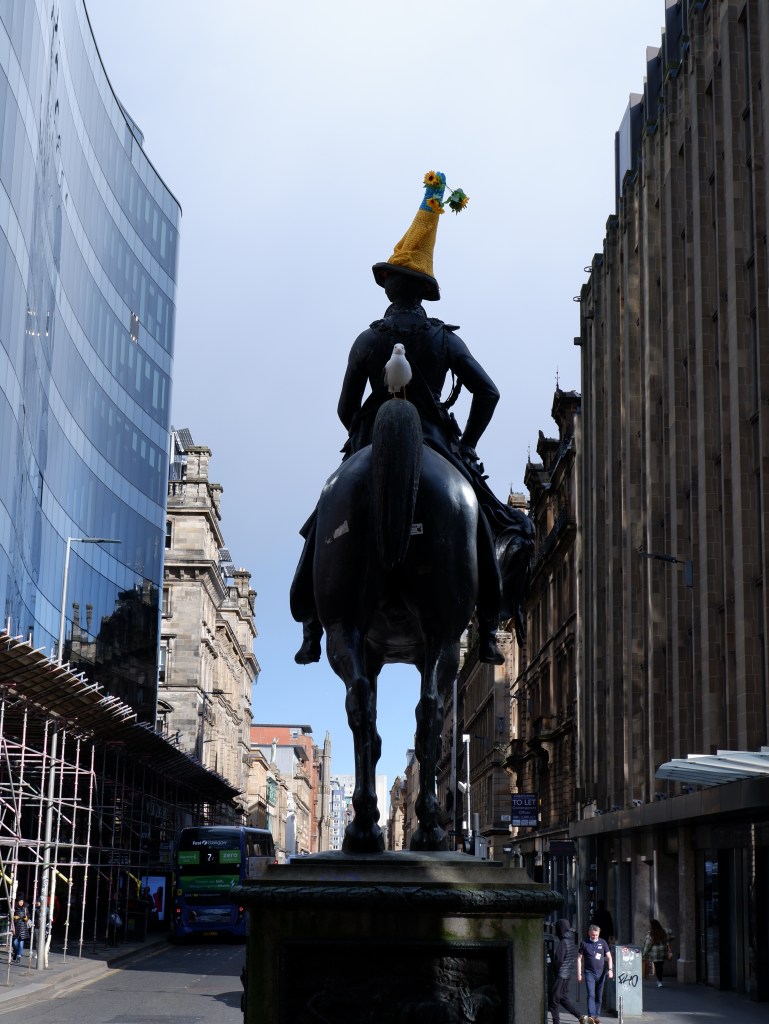
Glasgow’s iconic Duke of Wellington statue with a cone on his head, and a seagull on the horse’s rear. The cone is yarn-bombed with the colours of the Ukrainian flag.

This week the Library published a blogpost that I wrote about my work with Morgan’s ‘vast, unruly and magnificent’ scrapbooks and their relationship to the early medieval poetry, such as Beowulf, that Morgan was translating in the early part of his career.

[In the scrapbooks] medieval fragments jostle for space alongside pictures of jellyfish, sea anemones and goose barnacles, photographs of blasted snow-bound mountains, or surreptitious allusions to queer desire, as well as news items about cosmic rays and potential radio transmissions intercepted from outer space.

Scrapbooking old english – ‘the nerves must sometimes tingle and the skin flush’
MS Morgan C/1 p225-226 – this double-page spread shows a print of a jellyfish facing a panel from the early medieval Franks Casket

Putting together the blogpost and going back over my research notes made me realise just how much I had to say about Morgan’s scrapbooks. If Morgan’s desire for his translations of medieval texts was that ‘the nerves must sometimes tingle and the skin flush’, this had certainly been the effect on me of the visio-verbal scrapbooks and collages. Perhaps I will try and find another venue to write about the inspiration my research with Morgan provided for my own evening collage sessions in Glasgow.

One of the collages I produced while staying in Glasgow and working with the archive.

Pleasures of reading

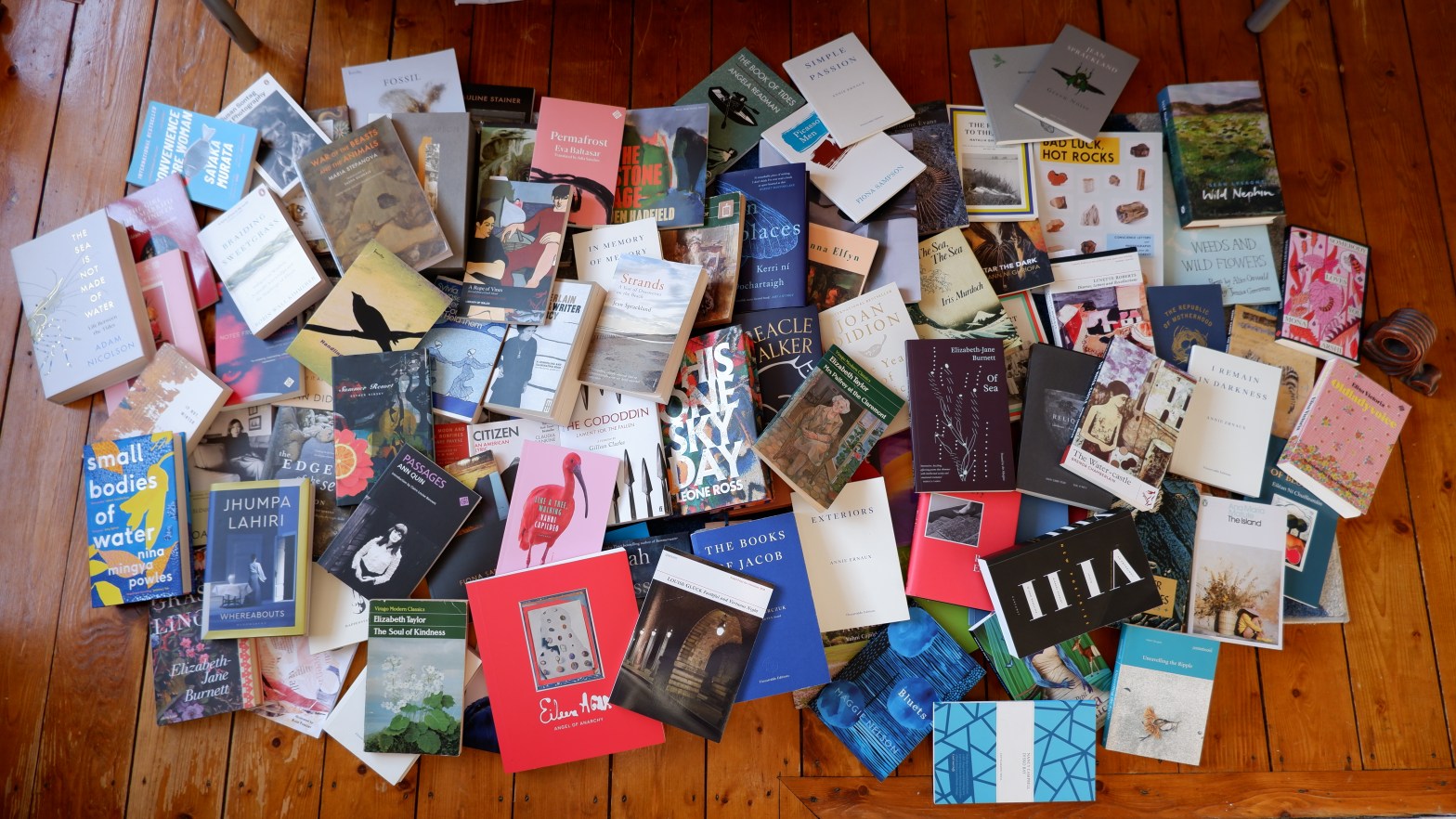
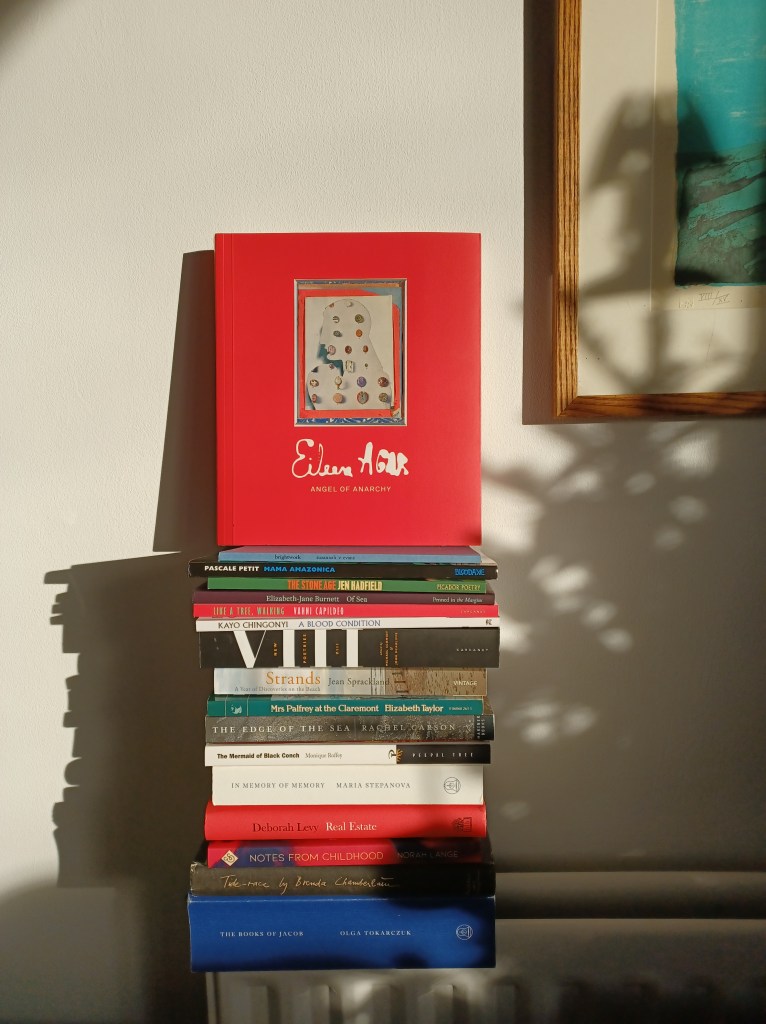
For the past four years I have kept a record of my favourite books of the year. Partly inspired by the bookstagrammers of instagram, I’ve posted a picture of a stack of my favourite books from each year since 2017. It’s an interesting way to reflect on the character of the year, the ideas and imagined places which I was reaching for when I turned to the little worlds bound on my bookshelf in search of escape and retreat.

My favourite books of 2021 (listed below)

One of the things I have learnt over the years is how much my reading is driven by mood. Realising this has helped me to feel more relaxed about the ways in which my reading habits are constantly transforming over time. Certain books find you at the perfect moment, while others languish a while waiting for you to be ready for them. Sometimes all I want to do is read, during afternoons on the sofa, before bed, and on journeys, and sometimes all I want to do is binge some tv and spend my time finishing a jigsaw puzzle!

During the pandemic my approach to reading poetry collections completely changed: suddenly all I wanted to do was devour poetry books. Before this I had never been an especially good reader of the poetry books I had collected. Sometimes I read them cover to cover, but more often I would start a book, put it down, and ‘fail’ over and over again to return to finish it. In the early pandemic I picked up my poetry books much more frequently, first thing in the morning, or at lunch and after work, and I started marking little pencil stars in the contents list so that I could easily find my way back to those poems that had moved or amazed me. And along the way, I learnt how to be a better reader of poetry.

Here is my book list from last year, just in case you are looking for a recommendation and, as you’ll see, my current reading habits and mood mean that it is dominated by poetry books and non-fiction.

My favourite books of 2021

Poetry:

Suzannah V. Evans, Brightwork (Guillemot Press)

Pascale Petit, Mama Amazonica (Bloodaxe)

Jen Hadfield, The Stone Age (Picador)

Elizabeth-Jane Burnett, Of Sea (Penned in the Margins)

Vahni Capildeo, Like a Tree, Walking (Carcanet)

Kayo Chingonyi, A Blood Condition (Cape)

New Poetries VIII (Carcanet)

Non-fiction:

Jean Sprackland, Strands: A Year of Discoveries on the Beach

Brenda Chamberlain, Tide-race (the subject of my current research, but also a dream memoir about life on Bardsey Island)

Rachel Carson, The Edge of the Sea

Maria Stepanova, In Memory of Memory, trans., Sasha Dugdale

Deborah Levy, Real Estate

Norah Lange, Notes from Childhood, trans., Charlotte Whittle

Eileen Agar: Angel of Anarchy

Fiction:

Elizabeth Taylor, Mrs Palfrey at the Claremont

Monique Roffey, The Mermaid of Black Conch

Olga Tokarczuk, The Books of Jacob, trans., Jennifer Croft

Parisian Rain and Parakeet Feathers

I had two poems published just before the end of 2021, which I thought it might be worth saying a little about here on the blog.

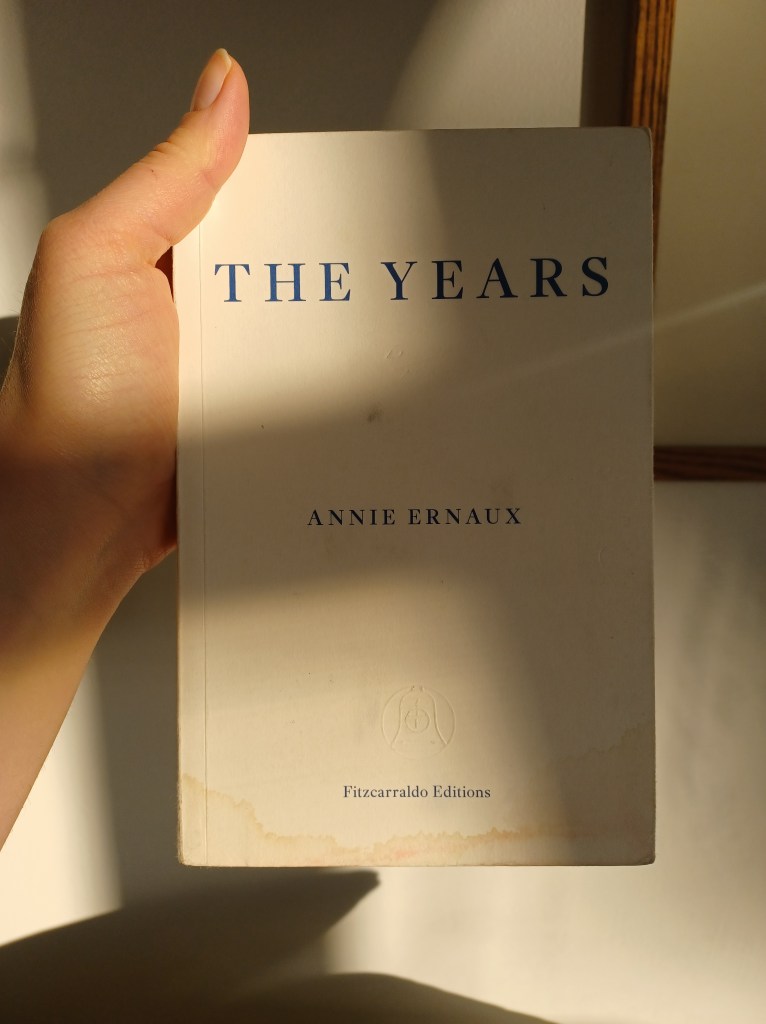
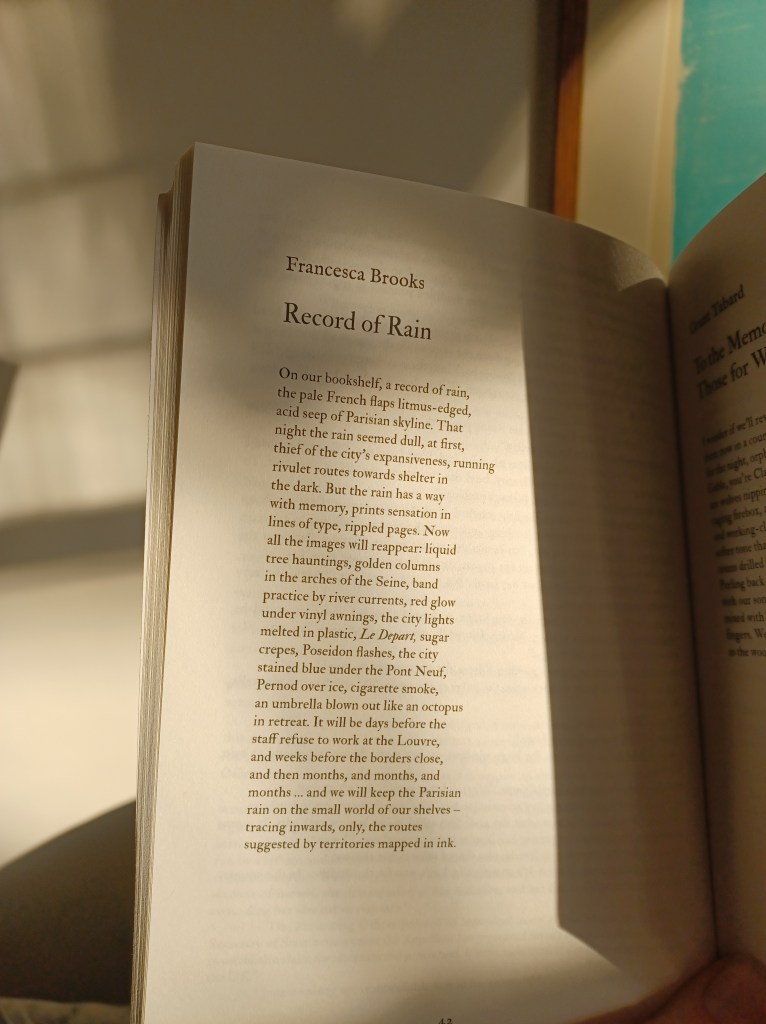
The first poem is in the wonderful Lighthouse Journal’s 23rd issue of poetry and short fiction, which you can purchase a copy of here. The poem, ‘Record of Rain’, begins with a rain-soaked copy of Annie Ernaux’s The Years (translated by Tanya Leslie) and the memories of Paris it provokes and preserves.

The launch is taking place online tonight at 7.30pm (GMT), just in case you happen to see this and want to join. It will be the first time I read my poems aloud for an audience.

The second poem is available to read online in Issue 9 of Tentacular Mag. ‘The Parakeet Feather of the Great North Wood’ rails against the city we moved away from in September 2020 and its toxic air.

Tentacular is a really interesting poetry magazine. Each writer is encouraged to stretch out one tentacle towards another contribution in the magazine (I chose Sasha Dugdale’s incredible ‘Philanthropy’ from Issue 7) and a second outwards into the web, towards some context.

Someone warns you/ that the blackberries are fume-dusted and rat-nibbled/ and you think of the long soak, hard water marbling/

purple, of sugar boiling the burst juices until the point/ of metamorphosis

‘The Parakeet Feather of The Great North Wood’
The picture is of a parakeet feather resting on the trunk of a tree.

‘Landlocked’, an essay for The Clearing

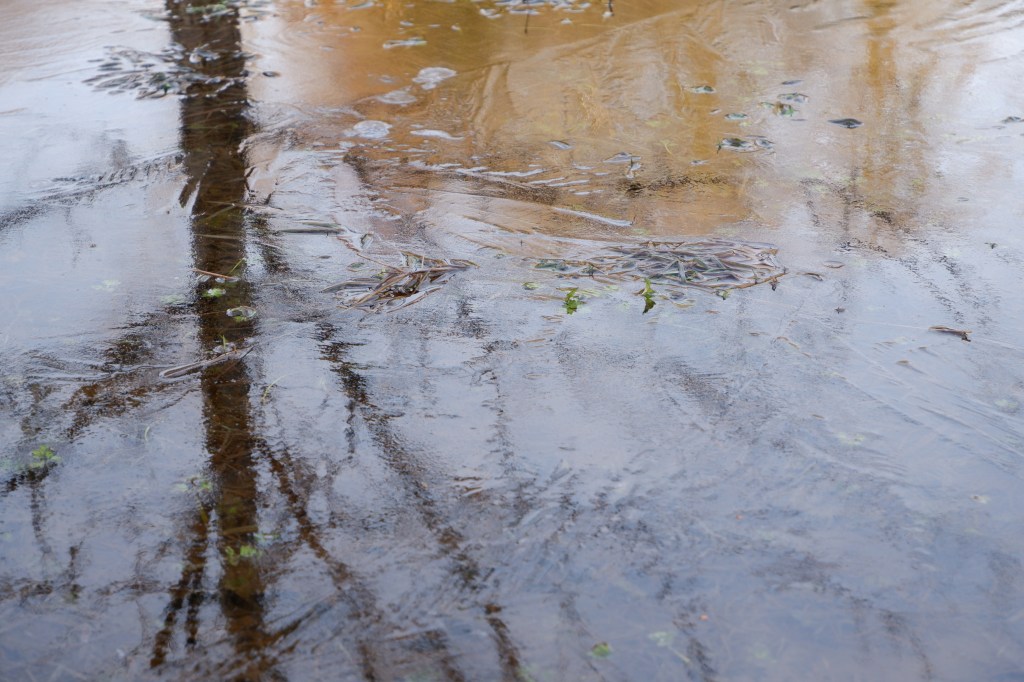
Photograph of reflections in ice at Fletcher Moss Park (author’s own)

Over the course of 2021 I slowly and incrementally worked on a prose essay that would set to paper some of the things I had been turning over in my mind on long, lockdown walks. The piece begins with an expression of longing for the sea and coastal edgelands, and thinks about how my move from south London to south Manchester during the pandemic offered me a strange, damp surrogate for this landscape.

The essay was published on The Clearing, a blog run by Little Toller Books, and you can read it here. I’m really grateful for the editorial input of Jon Woolcott, who helped to make it a tighter, more focused piece.

There is a dampness that sustains the teeming, liveliness of life on every surface of this landscape.

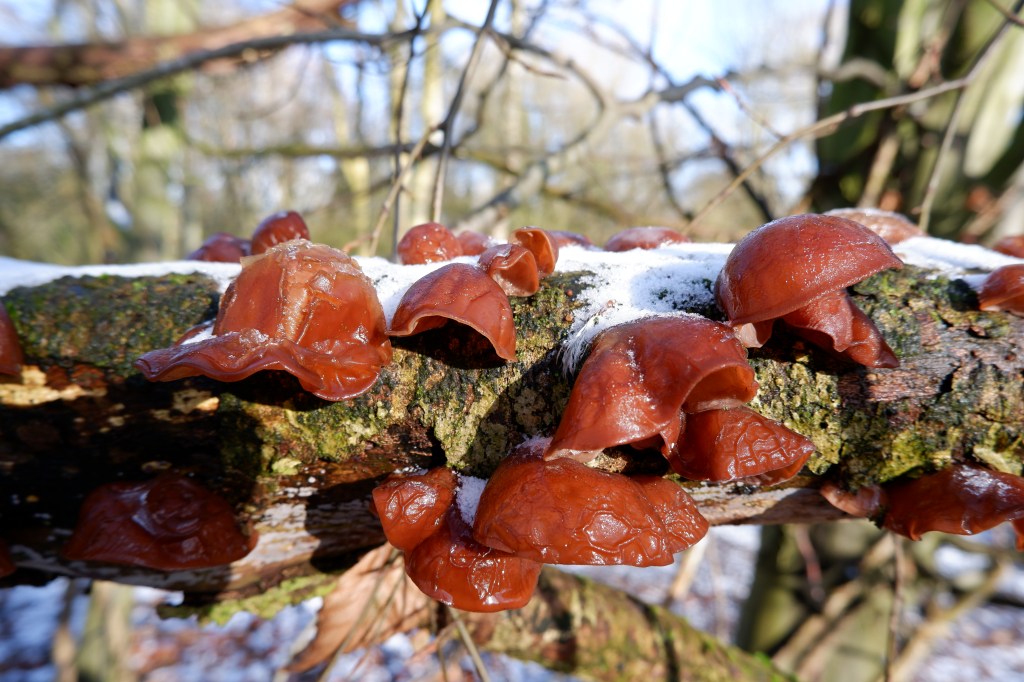
Photograph of frozen Jelly Ear fungi at Fletcher Moss Park (author’s own)

In the damp waterparks, woods and floodplains of Manchester, the meditative attention given to fossil hunting and beachcombing was translated into a search for fungi, lichens and slime moulds. The essay is about landscape and imagination and how a different kind of attention to the world might transform it. Here’s the link again, in case you are curious about the piece: https://www.littletoller.co.uk/the-clearing/landlocked-by-francesca-brooks/

Here was an alternate world to the rock pools of the coast: landlocked but equally various. The Scarlet Elfcups were radiant wounds in the dark of Stenner Woods at dusk. In the snow the Jelly Ear were rouged and glistening like obscene ripe fruit, their icy crusts peeling as if from plump, chapped lips slick with lip-gloss. In the Birch woods at Chorlton the planetary rings of the Turkey’s Tail were like hovering plates thrown into the hungry mouths of bark: a fungal solar system in orbit of the pale, silver trees. One afternoon, crawling into the low tangle of a den, I found a kind of bonnet mould flourishing on a hollowed, rotting limb. I thought I had found mushrooms hairy with the December frosts, spiked with fine glass tendrils, but this was Spinellus fusiger – the bonnet mushroom transformed into a beaded pin cushion.

‘Landlocked’ for The Clearing
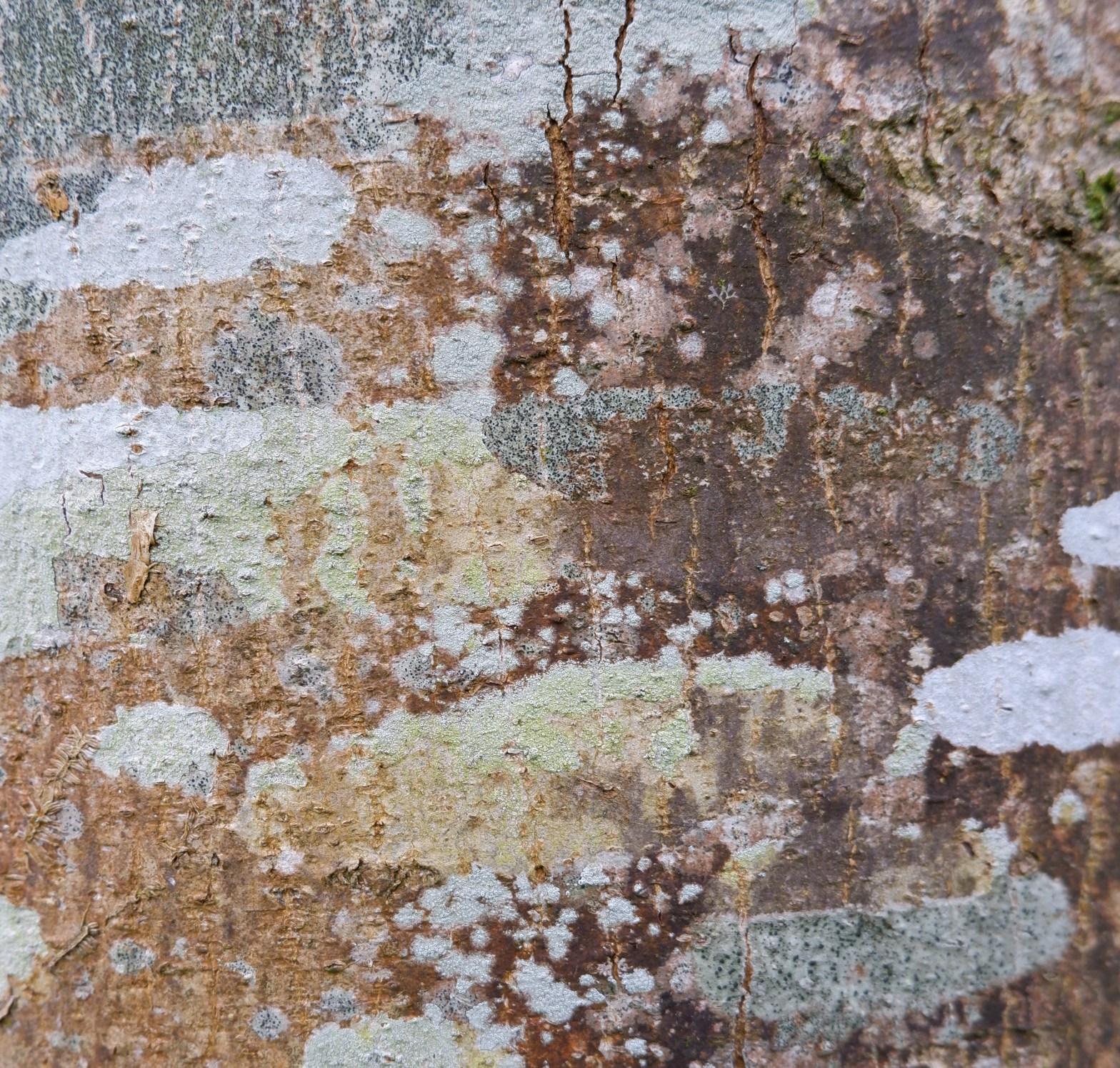
Photograph of a tree gaudy with lichens and moss in Fletcher Moss Park (author’s own)

‘Love Letters of the Hampstead Modernists’ & other poems

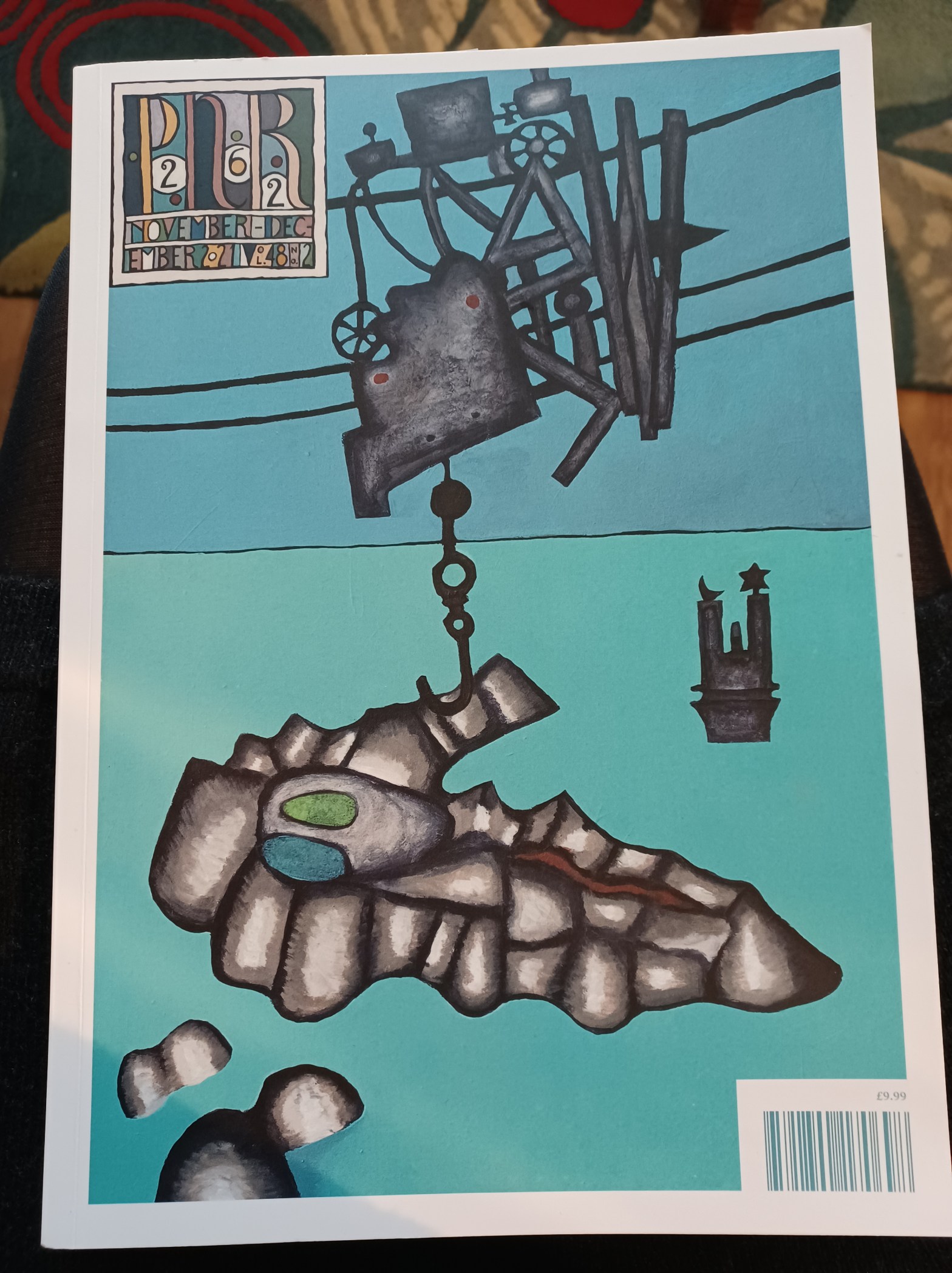
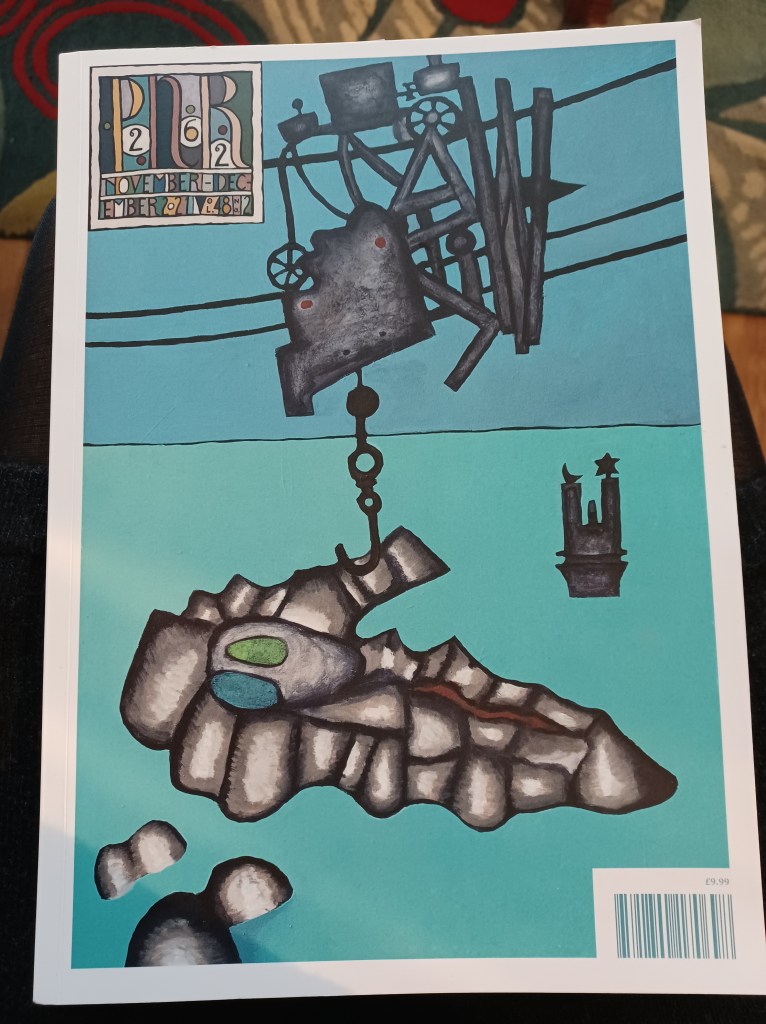
Picture of a copy of PN Review 262

Four of my poems have been published in issue 262 of PN Review. I’ve admired the journal and much of what Carcanet publishes for a long time, so this feels like something of a dream.

If you’re a subscriber, you can read the poems online here. Otherwise you can purchase a copy of the journal from Carcanet’s online shop.

I thought I would say a little something here about the creative debts of each of the poems.

The first of the poems, ‘Love letters of the Hampstead Modernists’, was written after reading Caroline Maclean’s Circles and Squares and is a surreal collage of love letters between the artists Barbara Hepworth and Ben Nicholson, and Eileen Agar and Paul Nash.

Love

you are pebble-headed

and starfish-mouthed,

dark as a lick of brine

and pocket-smoothed.

Love Letters of the Hampstead Modernists
Sculpture consisting of a shell stuck on top of sea urchin mounted on a base made out of woven bark Eileen Agar 1899-1991 Bequeathed to Tate Archive by Eileen Agar, 1992.
Image shows a man standing with the Puddingstone at Standon

‘Hertfordshire Puddingstone’ is the second poem. This came out of an incredible workshop led by the poet Liz Berry for Dialect Writers. I would definitely recommend looking for events and workshops run by them in the future.

The poem is named after a particular type of conglomerate sedimentary rock found only in the county where I grew up, Hertfordshire, and draws on a number of other local legends and histories.

The third poem is written for the oak outside the window of our former Sydenham flat, which was felled by the neighbours. ‘The Oak is Down’ is written after Charlotte Mew’s ‘The Trees are Down’ and I’m very grateful to a former UCL English student who introduced me to this poem.

The final poem ‘A Legend for Hazel’, is written for my niece.

In the garden all that’s left is a fingerprint

of unvarnished oak, a tall wound of mud

and moss where its shadow once stretched,

The Oak is Down
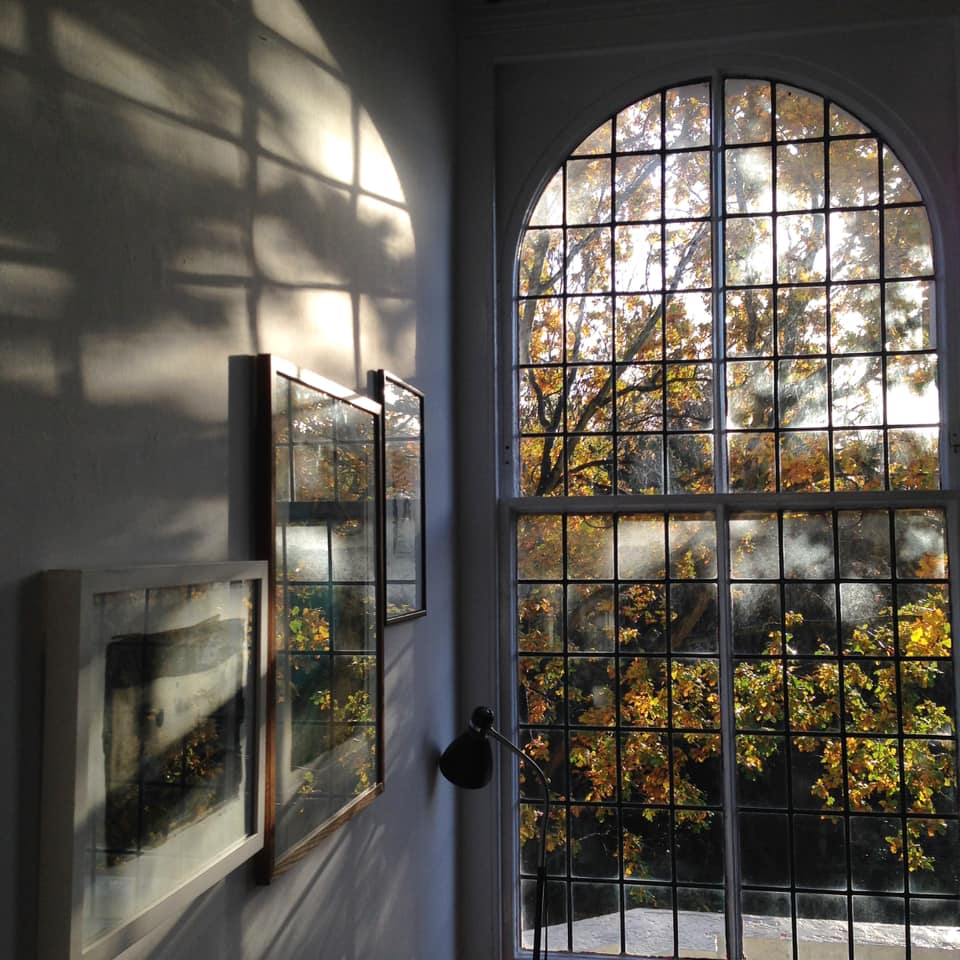
Photograph of the Oak Tree outside the window before it was felled.