Creativity and Community in the Lake District

My second commission for the art publication Corridor8 took me to the Lake District to a pair of exhibitions currently on display at Allan Bank in Grasmere – a Georgian villa where Wordsworth once lived, and Samuel Taylor Coleridge occasionally stayed. The exhibitions provided an excuse to finally spend some time in the Lake District; the opening weekend coincided with the beginnings of the flush of deliriously good spring weather we’ve had this year. We stayed in Rydal, just south of Grasmere, where the last of the daffodils in Dora Wordsworth’s field were being joined by the first of the bluebells and the pesto-perfume of the wild garlic. On our most adventurous day of walking we ascended Dungeon Ghyll to Stickle Tarn, and then looped on and up past the lake to tackle the craggy, lunar terrain of the Langdale Pikes.
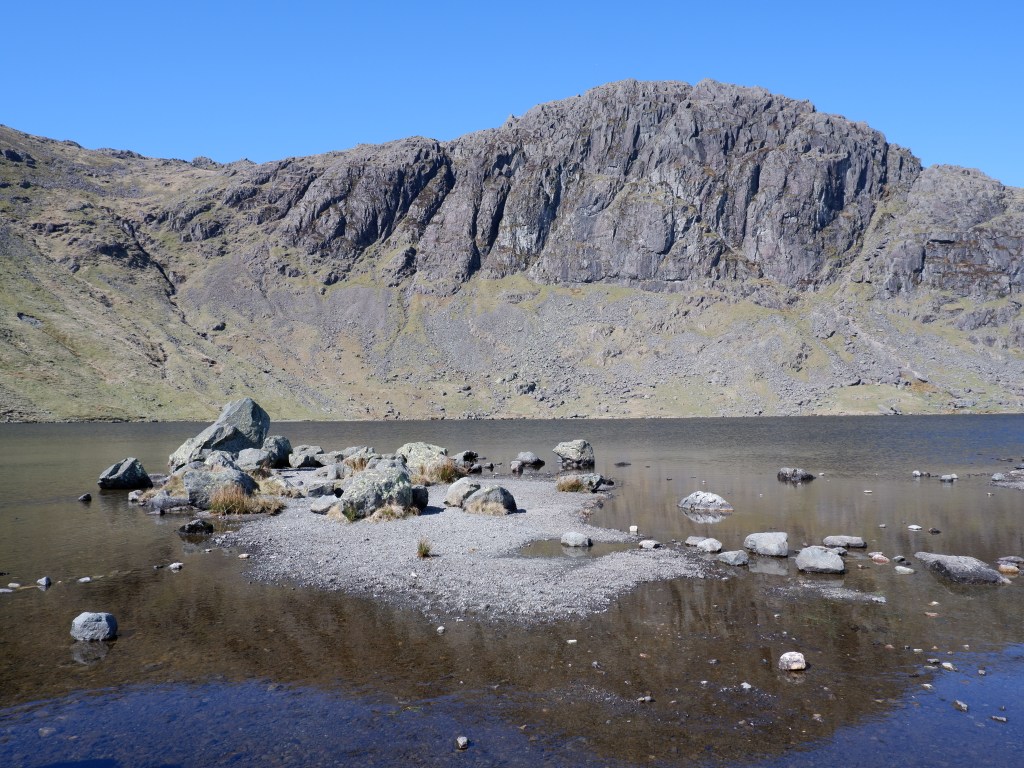
Stickle Tarn in the Lake District, on the way to Scafell Pike

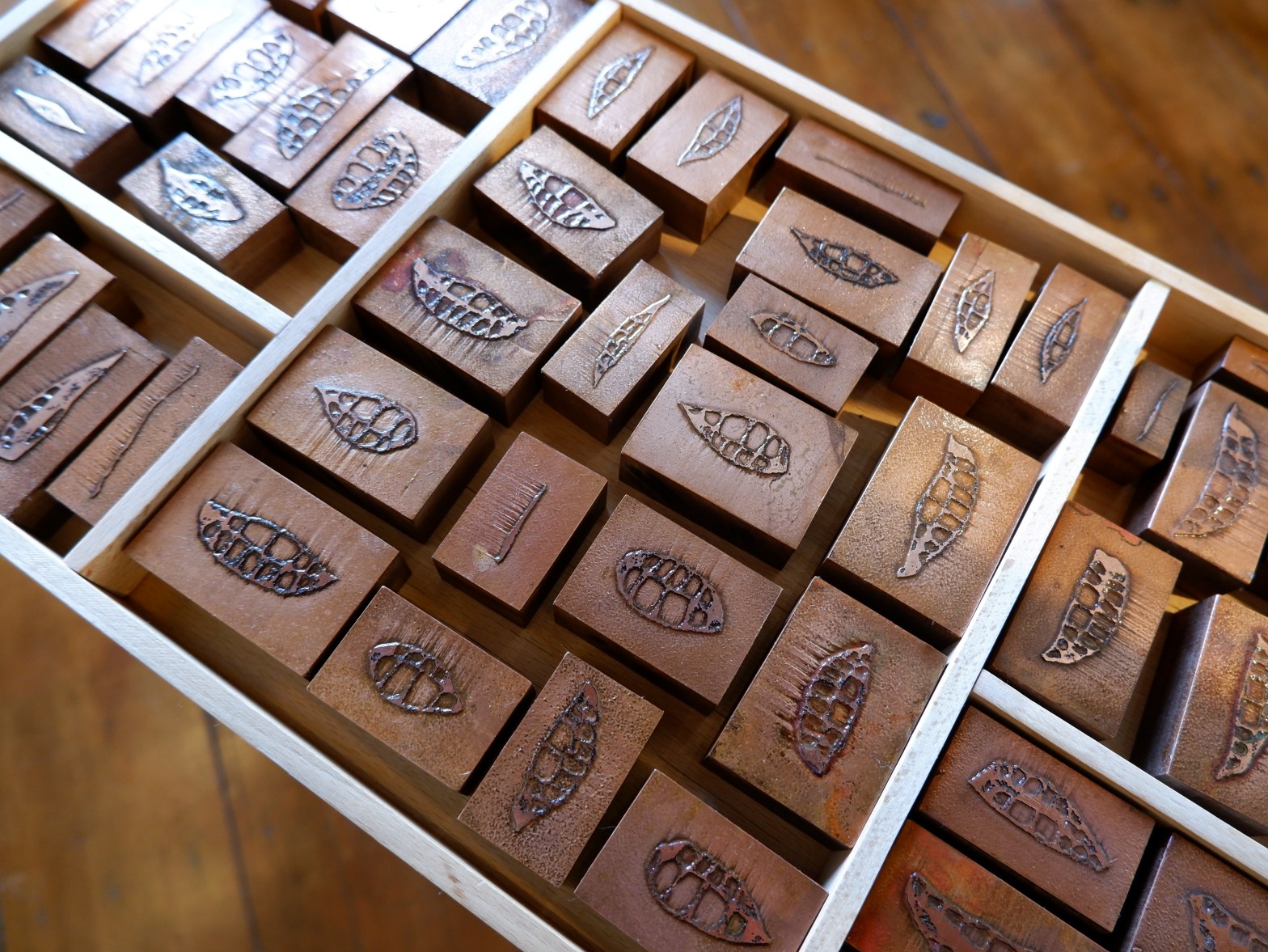
When I read about the two, interconnected exhibitions ahead of the trip, I felt like I couldn’t have been given a better commission. The first show ‘Women in Print: The Caravan Press’ tells the story of Gwyneth Alban Davis, a little known printmaker who lived in the creative community of the Lake District in the 1940s, while the second, Heather Mullender-Ross’s ‘All the Better to Hear you With’, draws on the creative legacy of Alban Davis and other artists in the Lake District to explore bird-song and its translation into language. Both exhibitions were archival – either presenting and reactivating documents, printing presses and printing blocks, from the archive, or documenting a response to the resonance of these archival materials for expanded printmaking now.

I’m fascinated and more than a little infatuated with the archive, in all its physical, abstract and metaphorical manifestations, and I’m especially interested in how we can use the archive to bring back into view the creative lives of women who were not the well-known starry geniuses (who now draw crowds to National Trust sites). I loved learning about Gwyneth Alban Davis, and it was especially interesting to encounter her through the practice of Heather Mullender-Ross, who had been working to retrace and recover her story over a number of years. Here’s one of the blown-up lightbox photographs of Gwyneth Alban Davis from the exhibition:
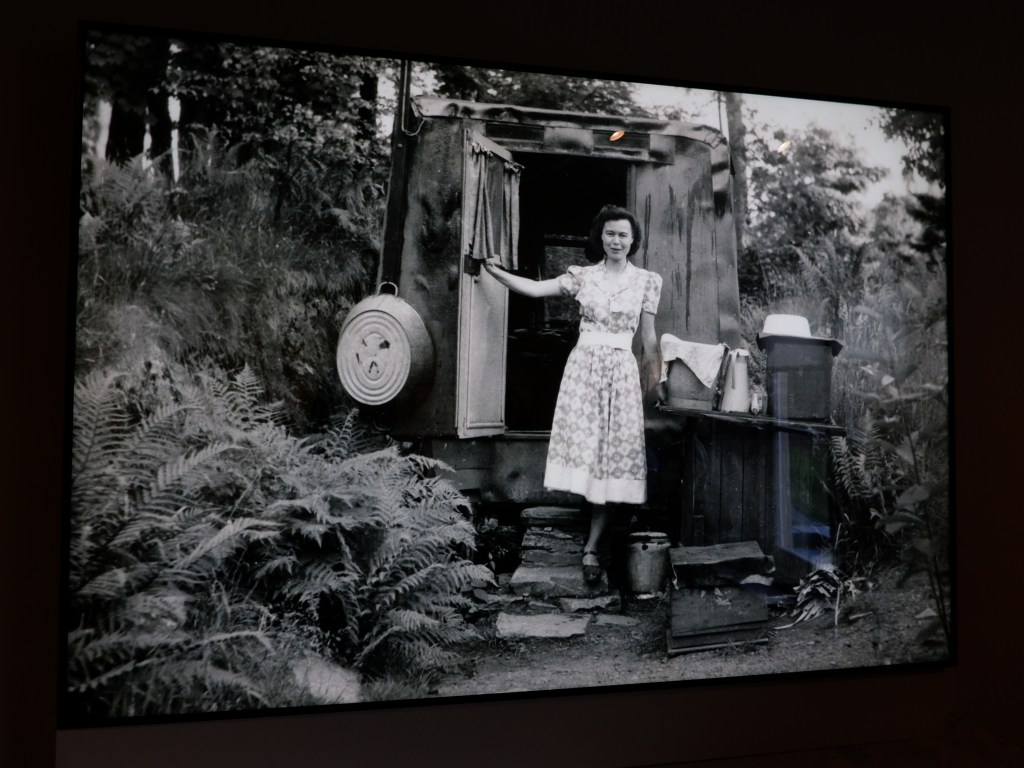
Lightbox photograph of Gwyneth Alban Davis in the exhibition at Allan Bank

Anyway, I feel like I’m danger of writing a whole other review of this show here, so instead I’ll send you over to Corridor8’s website to read the official piece. Here’s a little quote from the piece too, in case you need further temptation:

Precarity and contingency, as well as the resilience required to make art in the face of such conditions, are some of the themes that unite the exhibitions at Allan Bank. Mullender-Ross notes that the wooden trolleys of ‘All the Better to Hear You With’, although fixed to the floor for this exhibition, are on wheels and mobile like Alban Davis’s caravan. The width of the installation is also a nod to Gwyneth, and perhaps to the site-specific collage Schwitters made in response to her caravan and its ingenuity, as it matches the width of a cupboard in the original caravan. The exhibitions ask us to consider what kinds of space and resources are needed to make art in times of crisis, whether personal, political or environmental.
Art Writing and Art Reviews

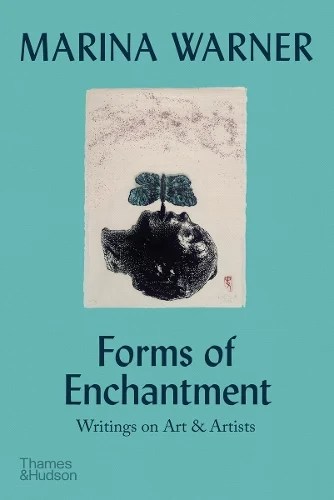
Earlier this year I was in a unfamiliar city for an interview for a job I was sure I wasn’t going to get. In the way I often do, I wandered into a bookshop in search of something like comfort – a new world into which I might retreat as I tried to forget the interview and let go of my anxiety about the wait for a decision. The book I chose was Marina Warner’s Forms of Enchantment, a collected volume of Warner’s sublime and fanciful writings on art and artists.

Back when I was in my early twenties Warner was a hero of mine. I loved fairy stories, folk tales, and their re-imaginings, I was obsessed with the art of Paula Rego, with exploring ideas of mythmaking and feminism. And, as I was testing out ideas about who I might become and what I might do with my life, I spent a lot of evenings and weekends writing art reviews in the lonely city I had recently moved to.

Cover of Marina Warner’s Forms of Enchantment

In the preface to her book Warner writes that she wishes to ‘argue for writerly ways of exploring art, as developed in literary tradition’. She goes on to argue that:

‘When I write about artworks and the artists who made them, I try to unite my imagination with theirs in an act of absorption that corresponds to the intrinsic pleasure of looking at art. Since the Greeks, ekphrasis has offered a way of capturing visual experience in words – but while I believe in close looking, description is not enough. I like to explore above all the range of allusions to stories and symbols; not to pin down the artwork as if it were a thesis or a piece of code, but to touch the springs of the work’s power. Art writing at its most useful should share in the dynamism, fluidity and passions of the objects of its inquiry.’ (pp. 8-9)

I love that phrase – ‘to touch the spring’s of the work’s power’ – because it suggests the liveliness of the work of art, its dynamic status as something still in process, as a thing with a resonance and agency all its own, waiting to meet the mind that extends towards it. Reading Warner’s collected art writings felt comforting and nostalgic: these words were familiar treasure ranging across subjects as diverse as Hieronymus Bosch, Tacita Dean, Helen Chadwick and Sigmar Polke. But in reading Warner’s work I also felt something like regret, or perhaps it was even jealousy: a slightly existential feeling of paths taken and those diverted from. Although I recognised the pleasure conveyed in Warner’s words, they seemed to more readily apply to my relationship with literary texts in my recent critical and academic writings: close reading rather than close looking. I remembered the pleasure of writing about art as an ‘act of absorption’, as Warner describes it, but it was a distant memory. I had a vision of myself in my early twenties on assignment for The Hackney Citizen, wandering the streets and galleries of east London and filing copy from coffee shops. Once upon a time I’d interviewed Conrad Ventur for Garageland magazine, reviewed shows by Georgia Hayes and art festivals in Aldeburgh, and even written catalogue essays for galleries in Berlin. What had I lost or left behind when I stopped doing this kind of writing?

All of this is a circuitous, expanded way of saying that when Corridor8 asked me to review an exhibition for their brilliant online publication, I leapt at the chance. Back in October I caught the train to Preston as the damp, warm, grey air was burnt to a blaze of blue by the autumn sun, to review ‘The Pearls and the Oyster’ at the Birley Studios. You can read the review I wrote about the show here.

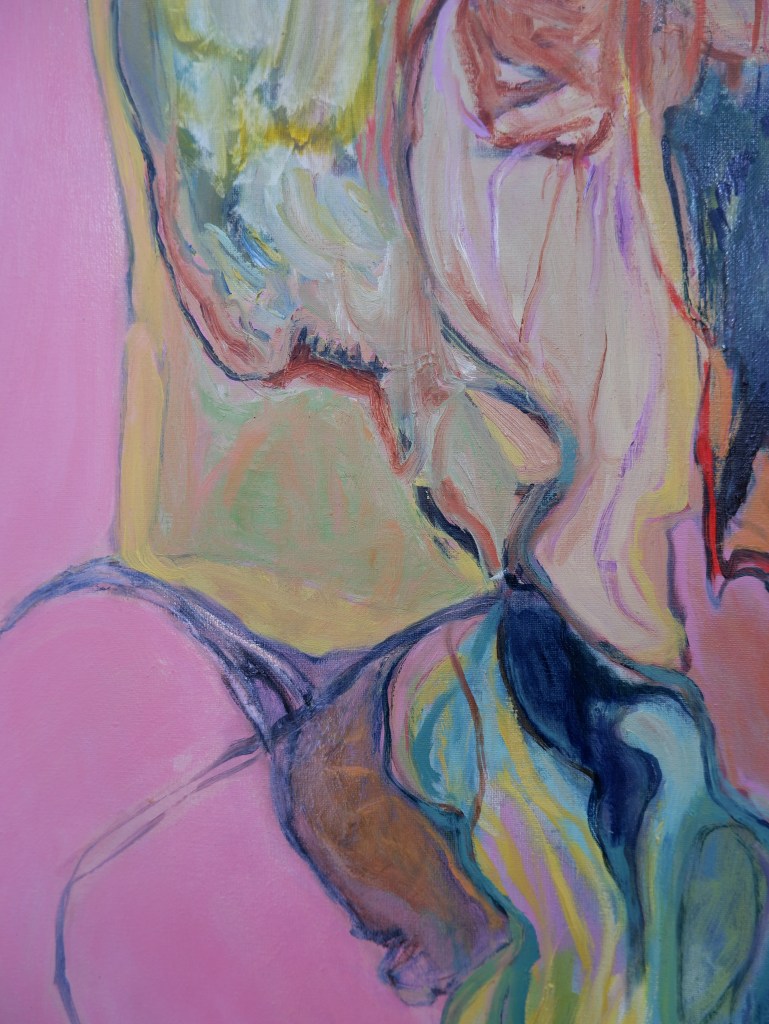
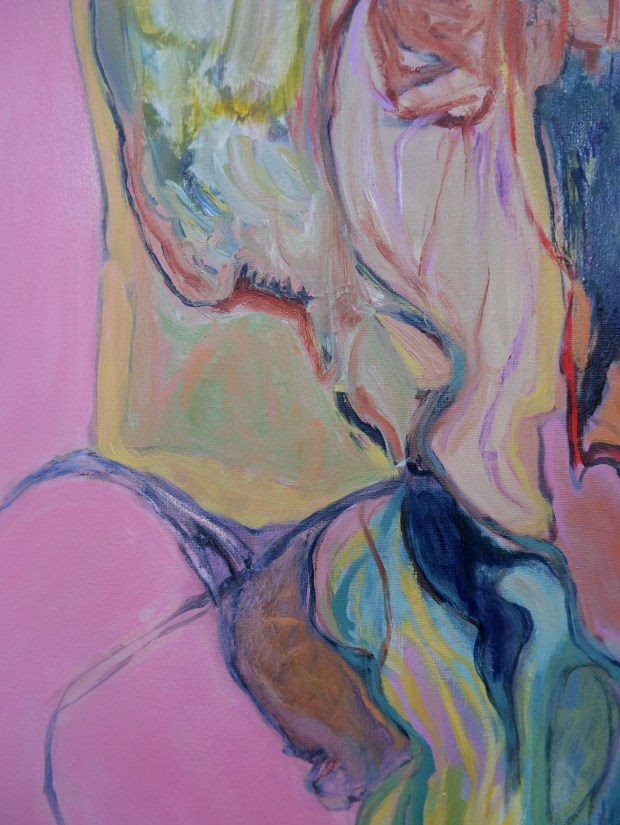
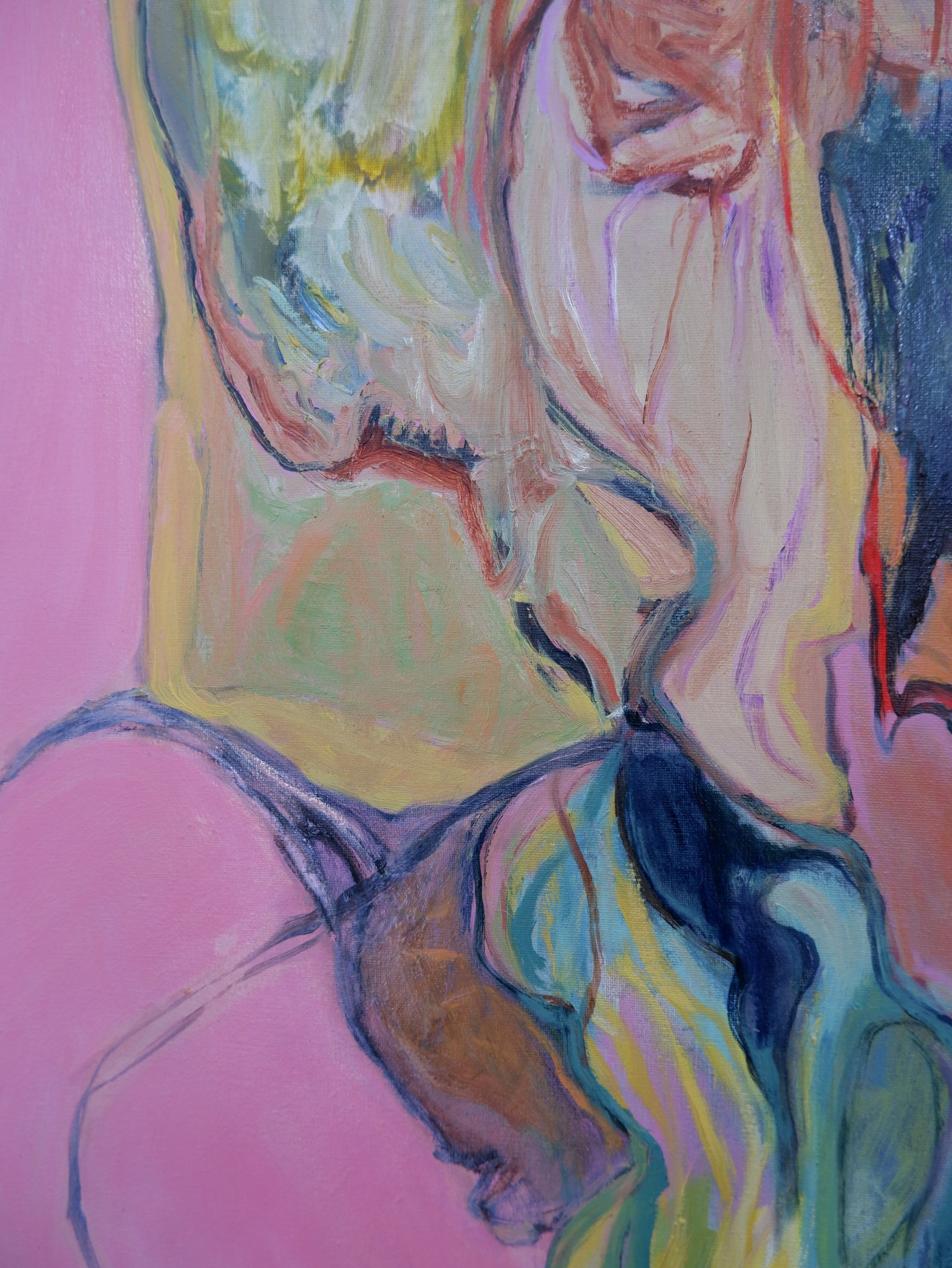
Detail of Nancy Collantine’s painting ‘Parafantasia’ (2024)

I bought a new notebook on the way in, chatted with the curator Jayne Simpson in the sun-filled gallery, and spent a very long time absorbed in the worlds of each of the thirteen paintings of this group show, making notes and wondering where this act of close looking might take me.

I’m just getting warmed up and hope I might have the chance to do something similar again:

What I enjoyed most about this exhibition was the opportunity to look closely and to see where that looking might take me. The ventilation shafts of the tunnels under the Mersey in Liverpool can have a surreal, space-age quality to them, but Payne’s ‘Shaft 1’ (2019), spray-painted with oil on concrete, brilliantly emphasises their dilapidated mundanity. The photo-realist quality of Payne’s work is challenged by an interest in the texture and characteristics of both medium and subject. Paint chipped or scraped from the surface of her concrete canvas replicates (or replaces) the peeling paintwork of the building depicted; the bubbling of paint in the muted sky might give us the sense that we are really looking at the concrete surface of Shaft 1 and not a depiction of it. Where does the painting end and the world begin? At the other end of the spectrum is Nancy Collantine’s ‘Para-Fantasia’ (2024), a painting whose abstract voluptuousness resists any attempt to find definitive signs in the cascade of colour, line and pattern that tumbles down the canvas over a tectonic plane of pink. Sometimes I think I catch a figure, a face, a landscape, and then the painting seems to rearrange itself again before my eyes.