
This summer I’ve run several creative writing workshops that have all drawn in part on the idea of ‘writing with scissors’ and techniques of collage and assemblage. In May I ran an Ecopoetry workshop with St Nick’s Nature Reserve in York for members of the public (at the invitation of Becca Drake). In June I ran a workshop for practice-based PhD Researchers at Manchester Metropolitan University on ‘Exploring Possible Forms’, in collaboration with Special Collections at the institution. Then towards the end of June I co-ran a creative-critical translation workshop with Fran Allfrey and Carl Kears for our ‘Revoicing Medieval Poetry’ project. I would love to run more creative workshops and I’m open to invitations, so I thought I’d write a little record of just one of the workshops here – ‘Exploring Possible Forms’ – as a sort of advert and call out.
I’ve taken the phrase ‘writing with scissors’ from Ellen Gruber Garvey’s book Writing with Scissors: American Scrapbooks from the Civil War to the Harlem Renaissance in which she writes about scrapbooking as a form of documentary or autobiography:
‘Every scrapbook holds its maker’s past and embodies a life of reading and saving. Every scrapbook is its own world, compelling and impossibly frustrating. […] Many scrapbooks are [also] diaries of sorts – a form of life writing that may or may not be chronological but records and preserves elements of life experience and memory cues.’ (pp. 14-5)
What Gruber Garvey points towards is the expressive possibilities of cutting out and assembling words and images, which can become a form of life-writing, but might also work as a documentary record or even as a space for fantasy and play. I’ve used some of these techniques myself – as an embodied research response to working with the scrapbooks of Edwin Morgan, for example, or as a way of writing about my longing to be by the sea in moments of landlock and writer’s block. For the ‘Exploring Possible Forms’ workshop I wanted to offer practice-based researchers an exploratory and collaborative space in which they would be encouraged to find new and embodied ways of approaching the writing they do for their PhD research.
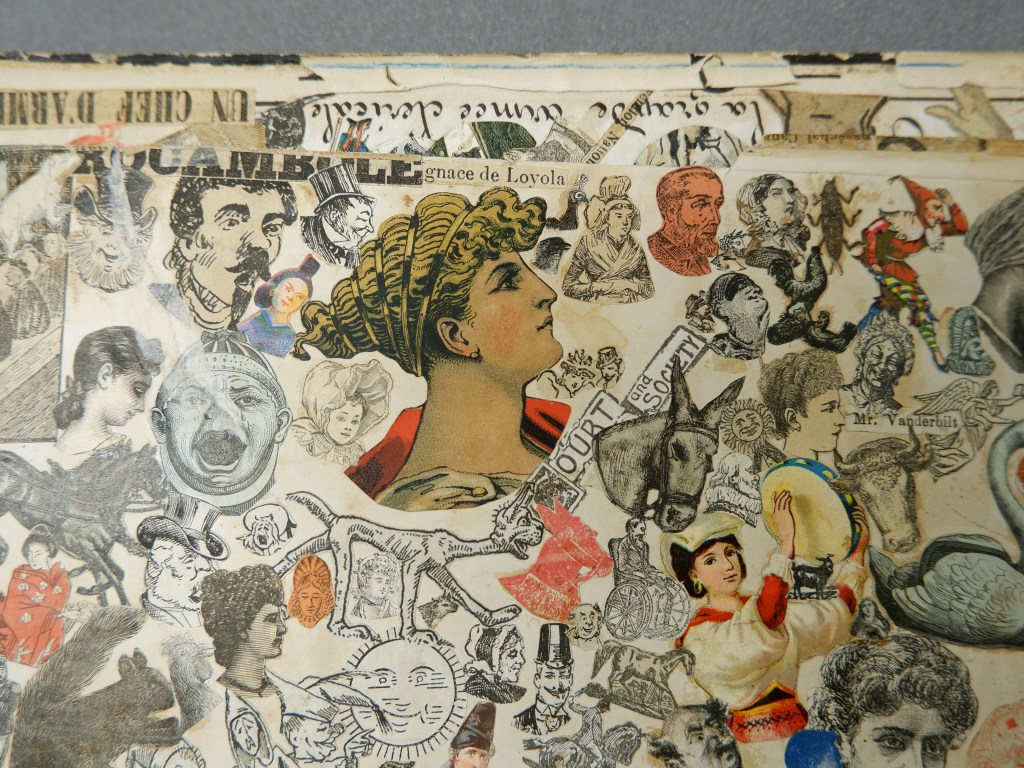
The other jumping off point was that Louise Clennell in Special Collections had offered to co-run something for our researchers. Louise would introduce us to some of MMU’s amazing collection of artists’ books, while my eye had been caught by some of the nineteenth-century scrapbooks that were on display as part of a temporary exhibition in the museum. The scrapbooks were collected by Harry Page in the twentieth century before being donated to the university. Page was a City Treasurer for Manchester Council and a Victorian ephemera and scrap fanatic: his collection is incredibly rich and varied. I was struck by how surreal and strange the pages displayed from scrapbooks 88 and 157 of the Harry Page Collection were, and the extent to which their playful quality (verging on Dada-esque, proto-collage) chimed with my own experiments with cut-out text and collage methods of writing.
As part of my preparation for the workshop, I spent a couple of afternoons in Special Collections with some of the Harry Page Scrapbooks, as selected by the librarians and archivists. Scrapbook 88, produced by one ‘Mary Watson’ in the 1820s or 30s, was the star of the selections. The faded blue, sugary pages of this scrapbook were filled with words, phrases and notes cut from diverse sources and rearranged haphazardly, sometimes in idiosyncratic little clusters. Something like a story began to develop in the detail of these clusters and across the pages, although the fragments of text were often so free-floating, disjointed and bizarrely laid out that it felt like you were reading a document written in code. The scrapbook begins with a handwritten letter, a kind of epistolary set-up for the fiction of the book, suggesting that it had been received by Mary Watson from the Bishop of Halam. A mystery unfolds in the clippings and clusters of concrete poetry that follow. Although not easy to decipher, the scrapbook is nevertheless fascinating for the glimpse it seems to give into a mind busy at creative work. Who was this book for? What was being communicated to a potential reader? What was being documented?
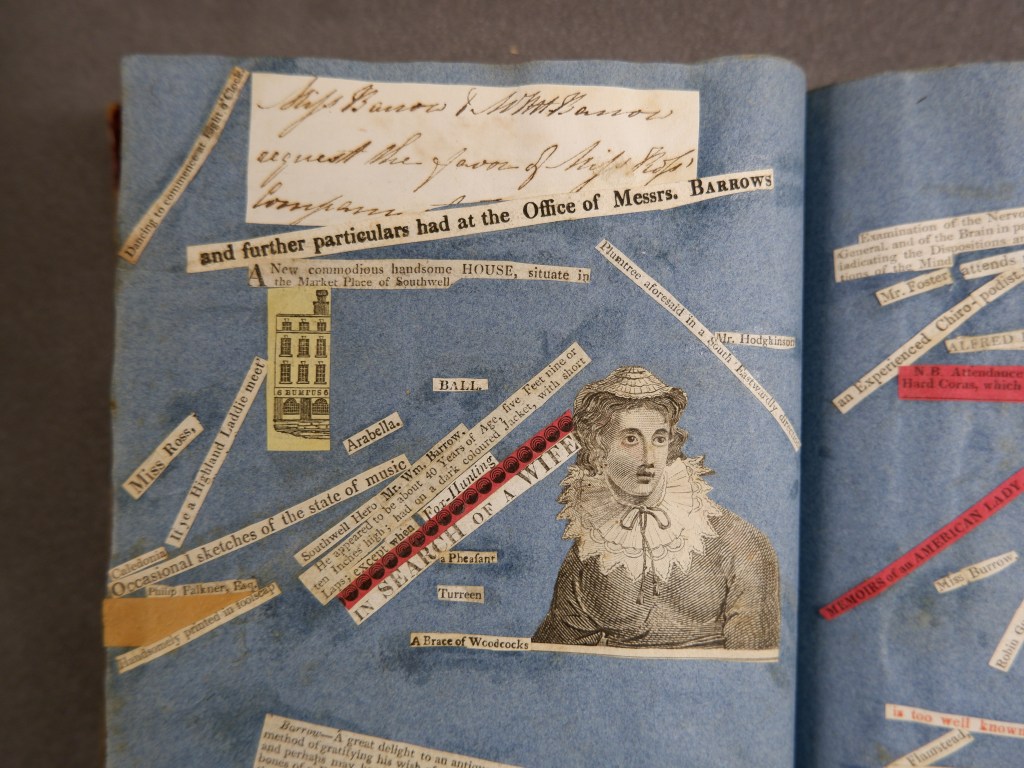
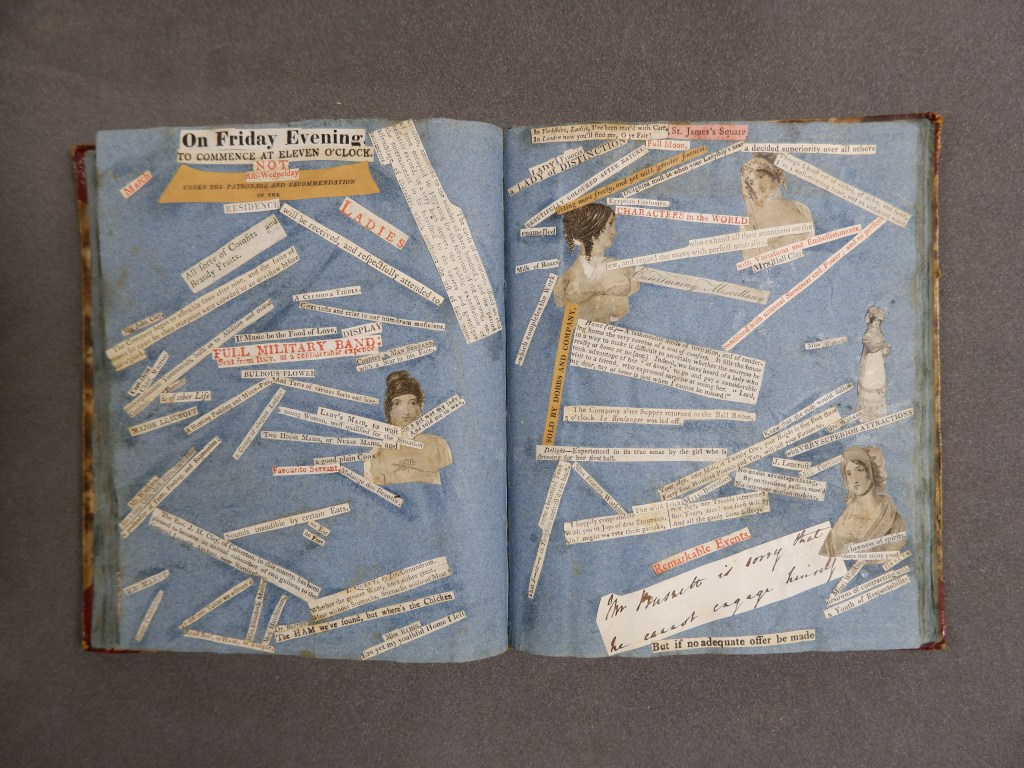
Page-spread from Scrapbook 88, Harry Page Collection, Manchester Metropolitan University Special Collections
During the workshop researchers had the chance to explore the ‘possible forms’ opened up by the artists’ books selected by Louise Clennell and some of the scrapbooks from the Harry Page Collection. For the more practical ‘making’ and ‘writing’ part of the workshop, I had asked the researchers to bring along a text they were working with as part of their PhD – this could be the abstract (description) of their own project, some writing they were currently stuck on, or a key text in their reading. We then began by cutting up and deconstructing this text, rearranging words and phrases to form a new, short text. I encouraged participants to work impulsively and associatively, without worrying about sentence structure, sense or grammar.
Next I directed participants to the other materials that had been brought into the room: old magazines, newspapers, books and journals that were available to them as a resource for words and images. They were now invited to create a visio-verbal composition over an extended period of time, which would develop or respond to the text they had created in the first half of the exercise. I drew on the words of Maria Carolina Cambre, who writes that: ‘Crucial to the art-making process is the ceding of control and allowing things to happen’. In collage, she adds, choices and emergent possibilities ‘are exceptionally abundant, with each torn edge having a fractal-like virtual presence inviting responses.’ Participants were encouraged to stray and cede control to these multiplying possibilities.
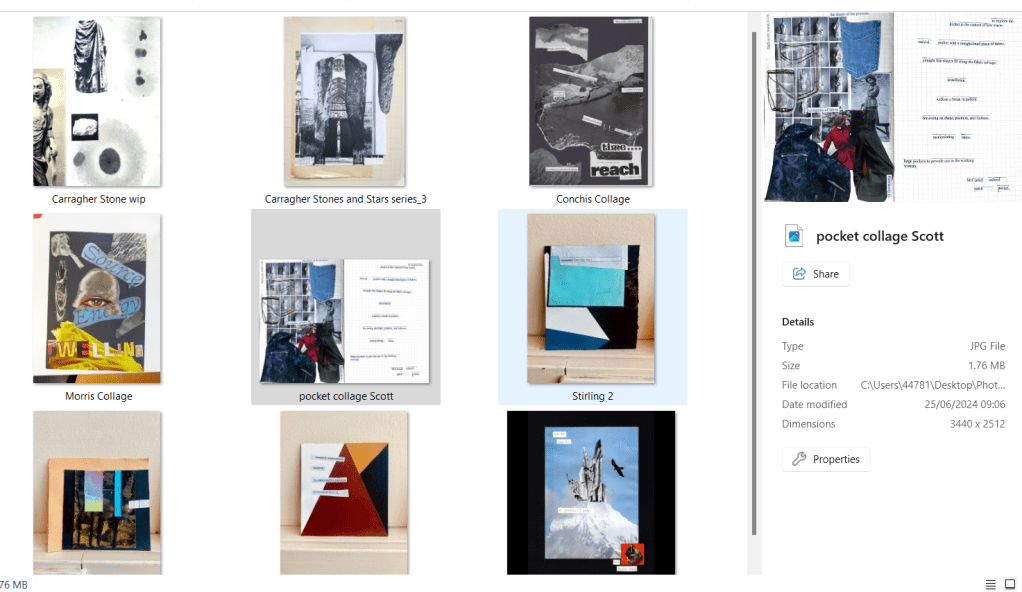
The image above shows some pictures of collages created during the workshop, which researchers have since sent to me. It’s no surprise that their responses should be so varied and beautiful, given how many of the participants were practising artists, designers and writers. This summer I’ve really enjoyed playing with collage and cut-up techniques with a range of different audiences. Feel free to get in touch if you’d like to talk more about a potential workshop.
 Francesca Brooks