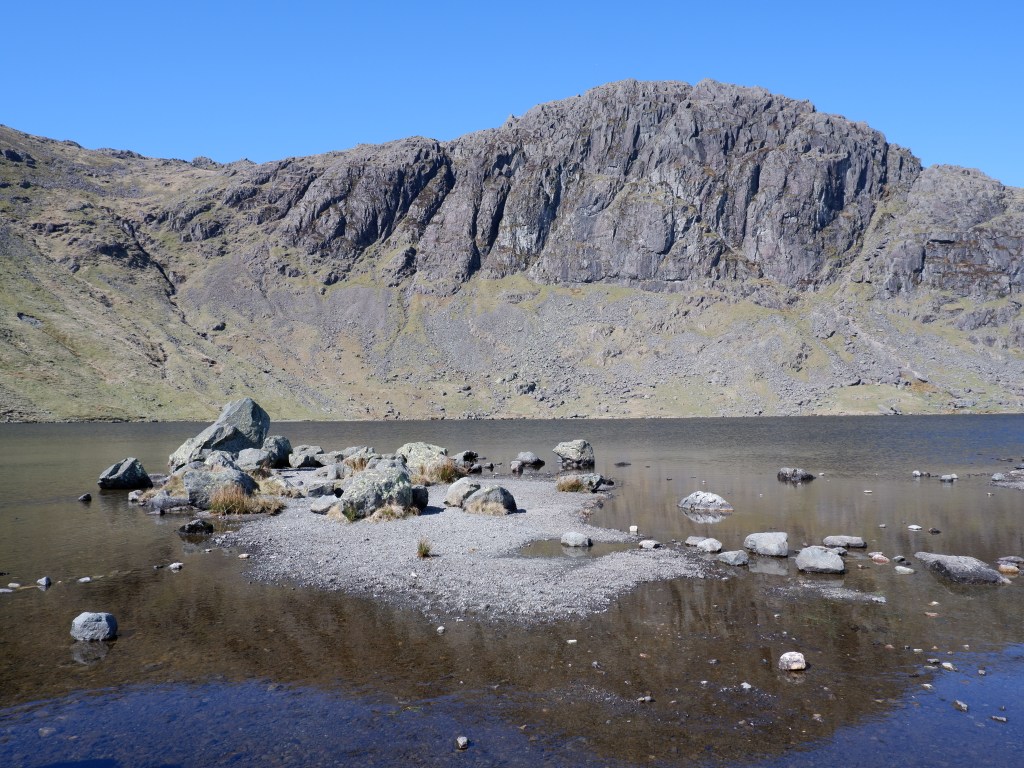
My second commission for the art publicationCorridor8 took me to the Lake District to a pair of exhibitions currently on display at Allan Bank in Grasmere – a Georgian villa where Wordsworth once lived, and Samuel Taylor Coleridge occasionally stayed. The exhibitions provided an excuse to finally spend some time in the Lake District; the opening weekend coincided with the beginnings of the flush of deliriously good spring weather we’ve had this year. We stayed in Rydal, just south of Grasmere, where the last of the daffodils in Dora Wordsworth’s field were being joined by the first of the bluebells and the pesto-perfume of the wild garlic. On our most adventurous day of walking we ascended Dungeon Ghyll to Stickle Tarn, and then looped on and up past the lake to tackle the craggy, lunar terrain of the Langdale Pikes.
Stickle Tarn in the Lake District, on the way to Scafell Pike
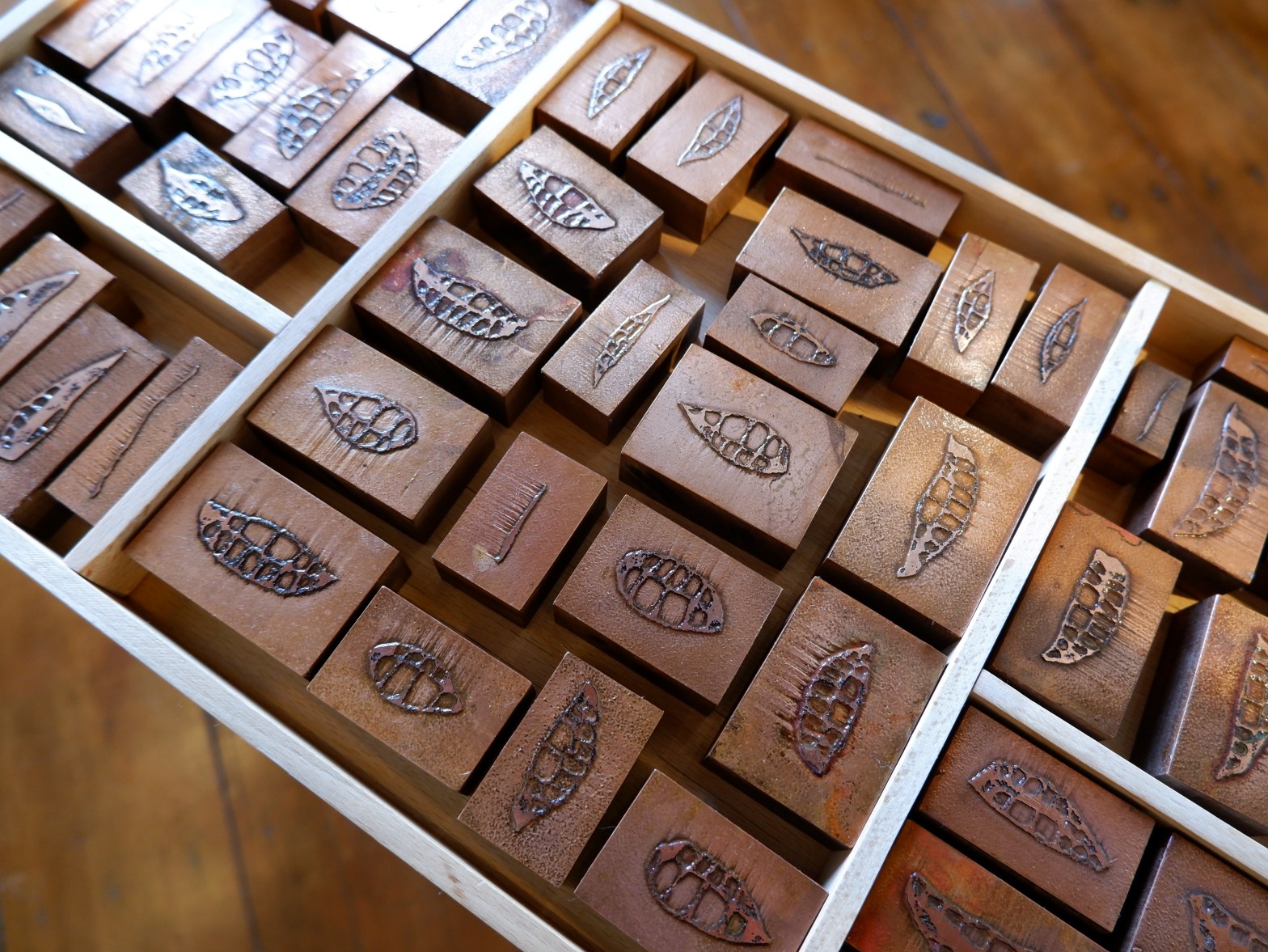
When I read about the two, interconnected exhibitions ahead of the trip, I felt like I couldn’t have been given a better commission. The first show ‘Women in Print: The Caravan Press’ tells the story of Gwyneth Alban Davis, a little known printmaker who lived in the creative community of the Lake District in the 1940s, while the second, Heather Mullender-Ross’s ‘All the Better to Hear you With’, draws on the creative legacy of Alban Davis and other artists in the Lake District to explore bird-song and its translation into language. Both exhibitions were archival – either presenting and reactivating documents, printing presses and printing blocks, from the archive, or documenting a response to the resonance of these archival materials for expanded printmaking now.
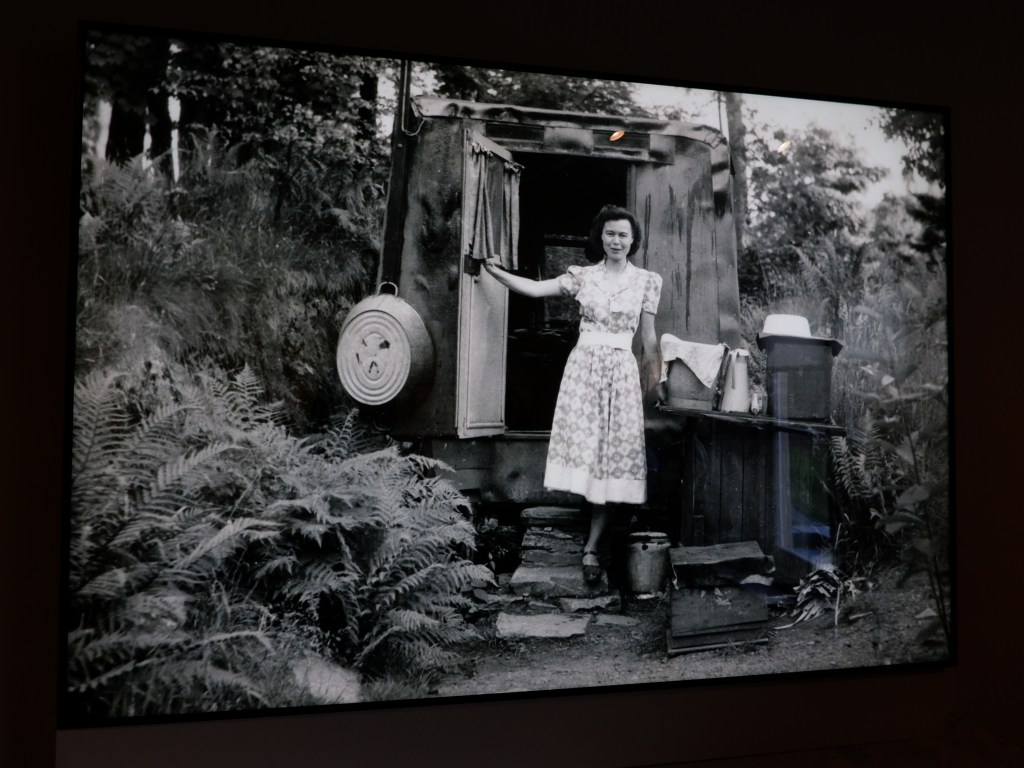
I’m fascinated and more than a little infatuated with the archive, in all its physical, abstract and metaphorical manifestations, and I’m especially interested in how we can use the archive to bring back into view the creative lives of women who were not the well-known starry geniuses (who now draw crowds to National Trust sites). I loved learning about Gwyneth Alban Davis, and it was especially interesting to encounter her through the practice of Heather Mullender-Ross, who had been working to retrace and recover her story over a number of years. Here’s one of the blown-up lightbox photographs of Gwyneth Alban Davis from the exhibition:
Lightbox photograph of Gwyneth Alban Davis in the exhibition at Allan Bank
Anyway, I feel like I’m danger of writing a whole other review of this show here, so instead I’ll send you over to Corridor8’s website to read the official piece. Here’s a little quote from the piece too, in case you need further temptation:
Precarity and contingency, as well as the resilience required to make art in the face of such conditions, are some of the themes that unite the exhibitions at Allan Bank. Mullender-Ross notes that the wooden trolleys of ‘All the Better to Hear You With’, although fixed to the floor for this exhibition, are on wheels and mobile like Alban Davis’s caravan. The width of the installation is also a nod to Gwyneth, and perhaps to the site-specific collage Schwitters made in response to her caravan and its ingenuity, as it matches the width of a cupboard in the original caravan. The exhibitions ask us to consider what kinds of space and resources are needed to make art in times of crisis, whether personal, political or environmental.
This summer I’ve run several creative writing workshops that have all drawn in part on the idea of ‘writing with scissors’ and techniques of collage and assemblage. In May I ran an Ecopoetry workshop with St Nick’s Nature Reserve in York for members of the public (at the invitation of Becca Drake). In June I ran a workshop for practice-based PhD Researchers at Manchester Metropolitan University on ‘Exploring Possible Forms’, in collaboration with Special Collections at the institution. Then towards the end of June I co-ran a creative-critical translation workshop with Fran Allfrey and Carl Kears for our ‘Revoicing Medieval Poetry’ project. I would love to run more creative workshops and I’m open to invitations, so I thought I’d write a little record of just one of the workshops here – ‘Exploring Possible Forms’ – as a sort of advert and call out.
I’ve taken the phrase ‘writing with scissors’ from Ellen Gruber Garvey’s book Writing with Scissors: American Scrapbooks from the Civil War to the Harlem Renaissance in which she writes about scrapbooking as a form of documentary or autobiography:
‘Every scrapbook holds its maker’s past and embodies a life of reading and saving. Every scrapbook is its own world, compelling and impossibly frustrating. […] Many scrapbooks are [also] diaries of sorts – a form of life writing that may or may not be chronological but records and preserves elements of life experience and memory cues.’ (pp. 14-5)
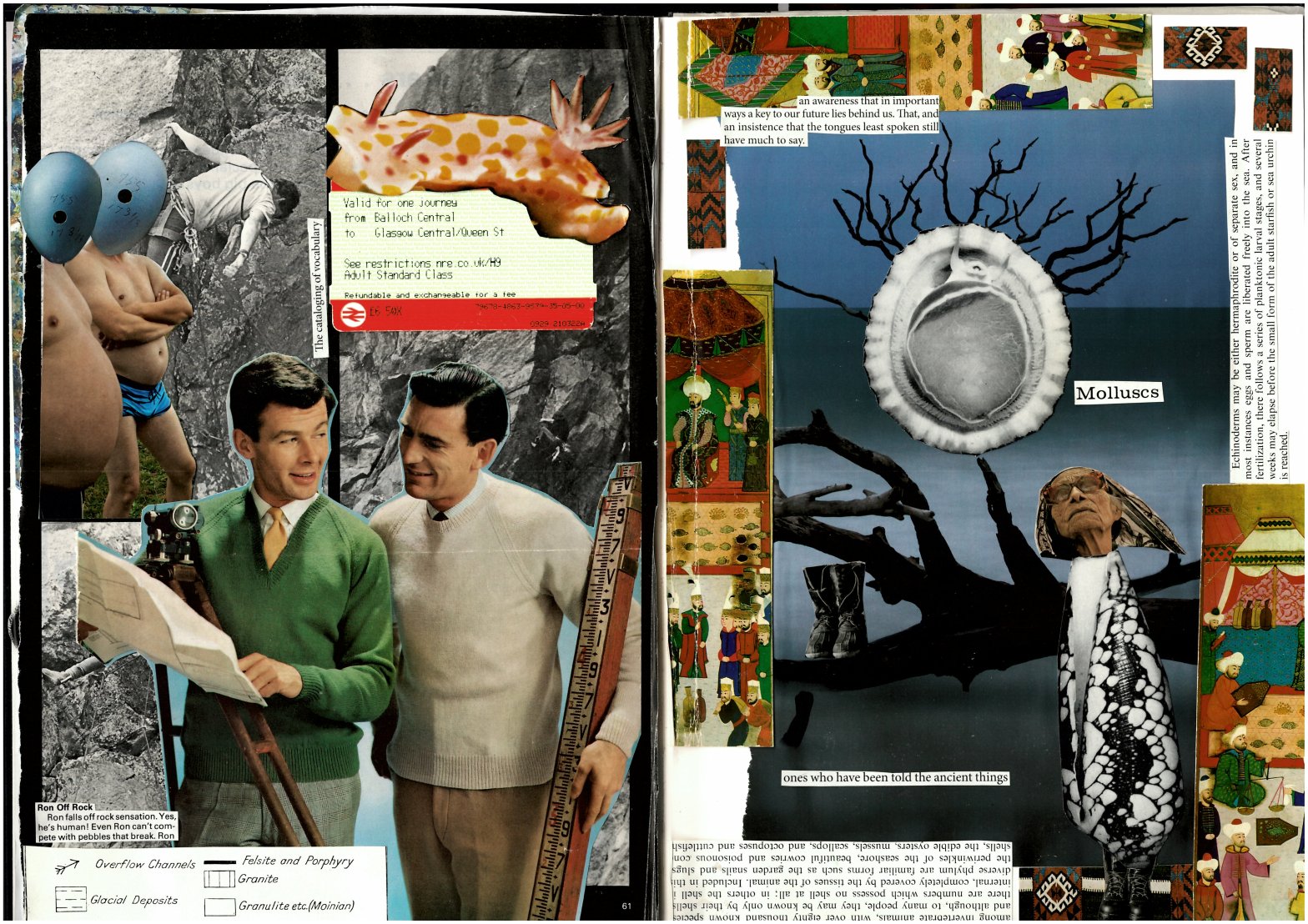
What Gruber Garvey points towards is the expressive possibilities of cutting out and assembling words and images, which can become a form of life-writing, but might also work as a documentary record or even as a space for fantasy and play. I’ve used some of these techniques myself – as an embodied research response to working with the scrapbooks of Edwin Morgan, for example, or as a way of writing about my longing to be by the sea in moments of landlock and writer’s block. For the ‘Exploring Possible Forms’ workshop I wanted to offer practice-based researchers an exploratory and collaborative space in which they would be encouraged to find new and embodied ways of approaching the writing they do for their PhD research.
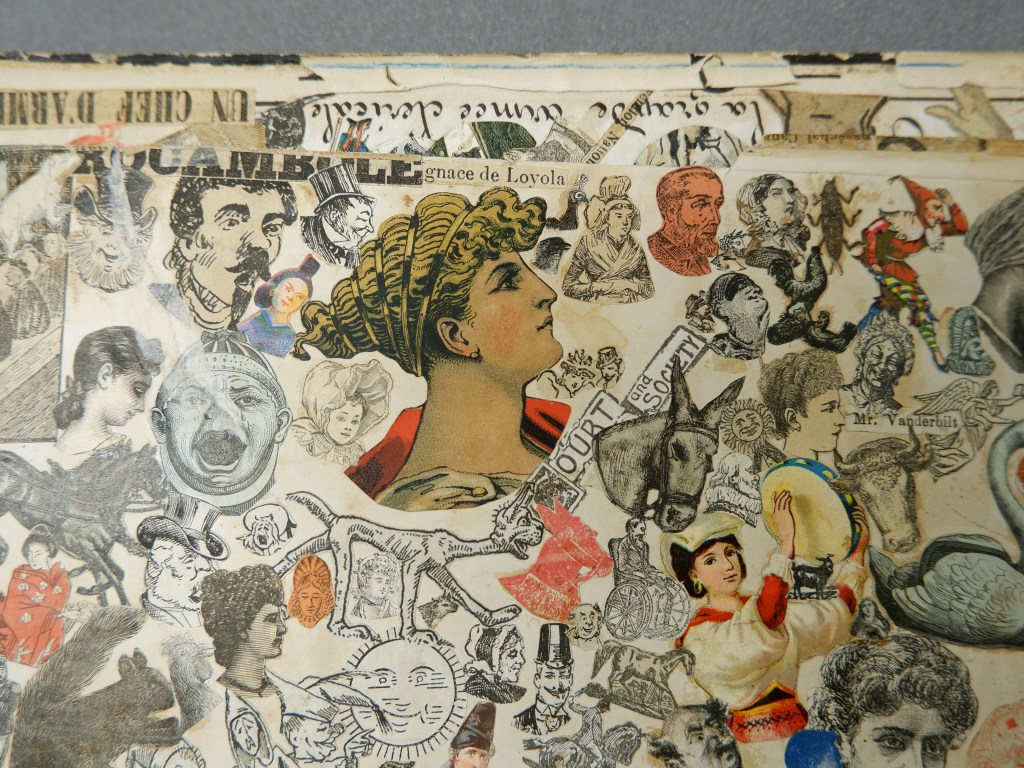
Detail of the inside cover of Scrapbook 234 in the Harry Robertson Page Collection, Manchester Metropolitan University’s Special Collections
The other jumping off point was that Louise Clennell in Special Collections had offered to co-run something for our researchers. Louise would introduce us to some of MMU’s amazing collection of artists’ books, while my eye had been caught by some of the nineteenth-century scrapbooks that were on display as part of a temporary exhibition in the museum. The scrapbooks were collected by Harry Page in the twentieth century before being donated to the university. Page was a City Treasurer for Manchester Council and a Victorian ephemera and scrap fanatic: his collection is incredibly rich and varied. I was struck by how surreal and strange the pages displayed from scrapbooks 88 and 157 of the Harry Page Collection were, and the extent to which their playful quality (verging on Dada-esque, proto-collage) chimed with my own experiments with cut-out text and collage methods of writing.
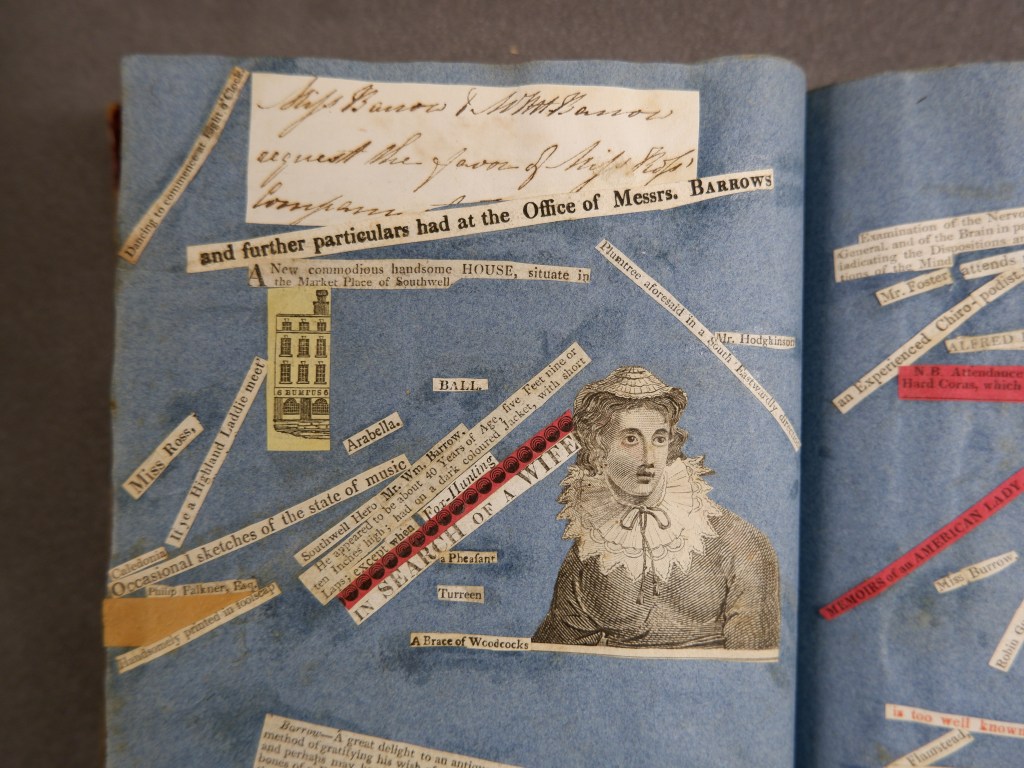
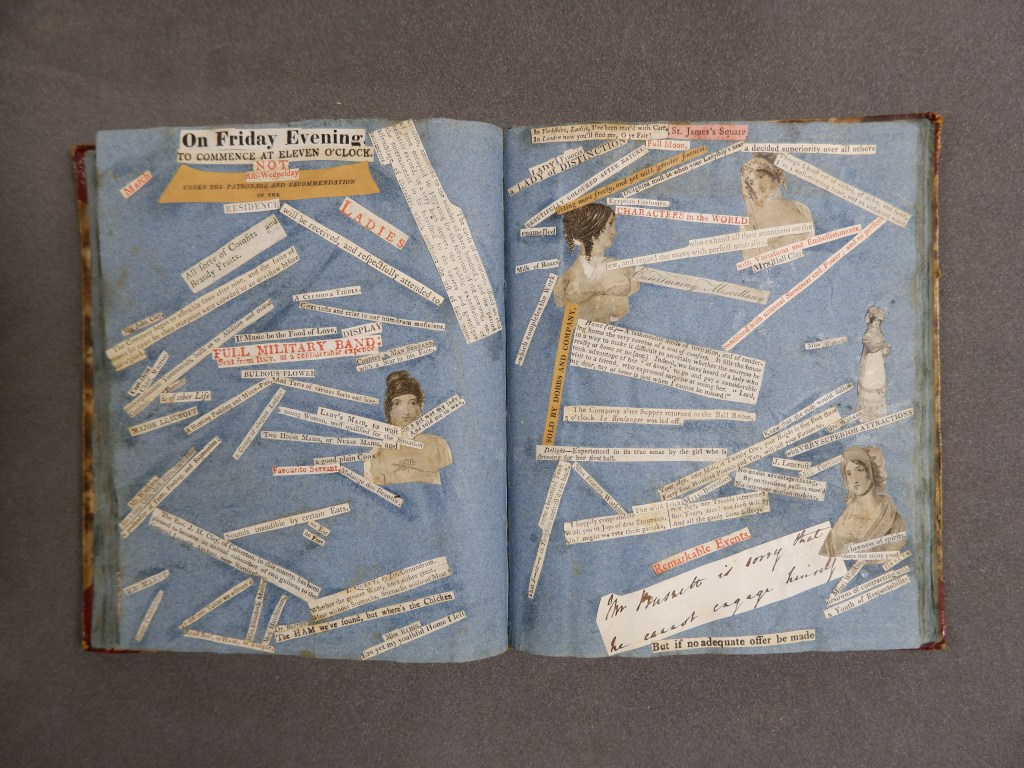
As part of my preparation for the workshop, I spent a couple of afternoons in Special Collections with some of the Harry Page Scrapbooks, as selected by the librarians and archivists. Scrapbook 88, produced by one ‘Mary Watson’ in the 1820s or 30s, was the star of the selections. The faded blue, sugary pages of this scrapbook were filled with words, phrases and notes cut from diverse sources and rearranged haphazardly, sometimes in idiosyncratic little clusters. Something like a story began to develop in the detail of these clusters and across the pages, although the fragments of text were often so free-floating, disjointed and bizarrely laid out that it felt like you were reading a document written in code. The scrapbook begins with a handwritten letter, a kind of epistolary set-up for the fiction of the book, suggesting that it had been received by Mary Watson from the Bishop of Halam. A mystery unfolds in the clippings and clusters of concrete poetry that follow. Although not easy to decipher, the scrapbook is nevertheless fascinating for the glimpse it seems to give into a mind busy at creative work. Who was this book for? What was being communicated to a potential reader? What was being documented?
Detail from Scrapbook 88, Harry Page Collection, Manchester Metropolitan University Special Collections Page-spread from Scrapbook 88, Harry Page Collection, Manchester Metropolitan University Special Collections
During the workshop researchers had the chance to explore the ‘possible forms’ opened up by the artists’ books selected by Louise Clennell and some of the scrapbooks from the Harry Page Collection. For the more practical ‘making’ and ‘writing’ part of the workshop, I had asked the researchers to bring along a text they were working with as part of their PhD – this could be the abstract (description) of their own project, some writing they were currently stuck on, or a key text in their reading. We then began by cutting up and deconstructing this text, rearranging words and phrases to form a new, short text. I encouraged participants to work impulsively and associatively, without worrying about sentence structure, sense or grammar.
Next I directed participants to the other materials that had been brought into the room: old magazines, newspapers, books and journals that were available to them as a resource for words and images. They were now invited to create a visio-verbal composition over an extended period of time, which would develop or respond to the text they had created in the first half of the exercise. I drew on the words of Maria Carolina Cambre, who writes that: ‘Crucial to the art-making process is the ceding of control and allowing things to happen’. In collage, she adds, choices and emergent possibilities ‘are exceptionally abundant, with each torn edge having a fractal-like virtual presence inviting responses.’ Participants were encouraged to stray and cede control to these multiplying possibilities.
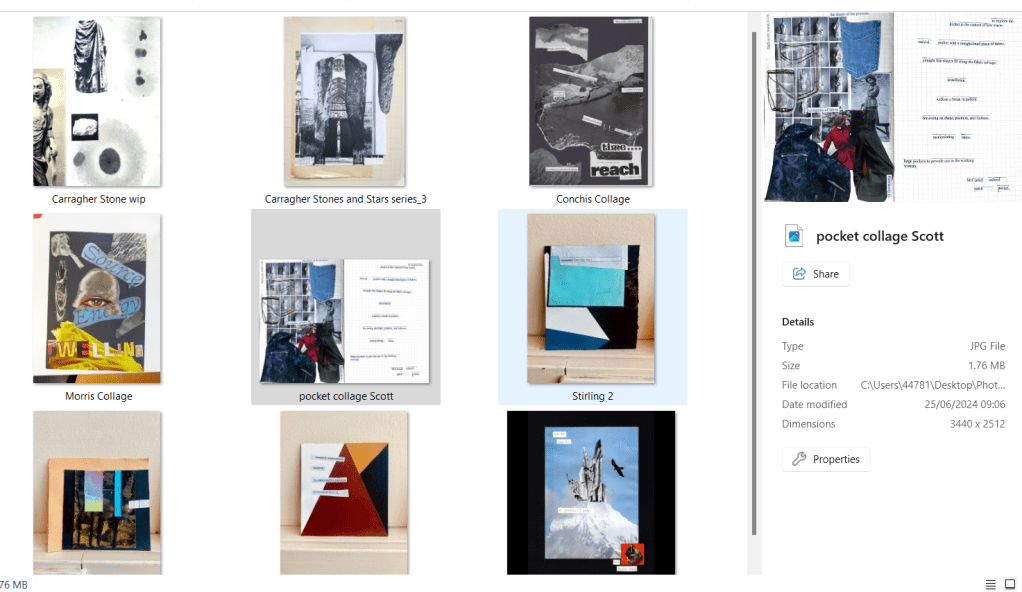
A screenshot of photographs of collages created by the researchers during the workshop
The image above shows some pictures of collages created during the workshop, which researchers have since sent to me. It’s no surprise that their responses should be so varied and beautiful, given how many of the participants were practising artists, designers and writers. This summer I’ve really enjoyed playing with collage and cut-up techniques with a range of different audiences. Feel free to get in touch if you’d like to talk more about a potential workshop.
Last month, ahead of the launch of issue 15.2, two pieces I wrote or co-wrote were published with postmedieval: a journal of medieval culture studies. Both gave me the opportunity to write and think more about Edwin Morgan’s scrapbooks in the University of Glasgow Archives, and to reflect on how my month spent with them in 2022 has continued to shape my creative and critical practice.
For the first piece, ‘Medieval re-creation and translation in the archives of Derek Jarman and Edwin Morgan: A Dialogue’, I spent several months corresponding with the artist and writer E. K. Myerson over email in a kind of ‘show and tell’. As our creative-critical conversation unfolded in 2023, we discussed the queer medievalisms of Edwin Morgan and Derek Jarman, and reflected on what it means to be a medievalist working in a modern archive where we might feel more intimately connected with the touch and desires of the subjects of our research. In the second half of our conversation we shared how we had each responded creatively to our encounter with the archive: I, by making a Glasgow scrapbook of collage pages and page-spreads, and Myerson by working on a Jarmanesque film called ‘A submerged reliquary of a Kentish saint’.
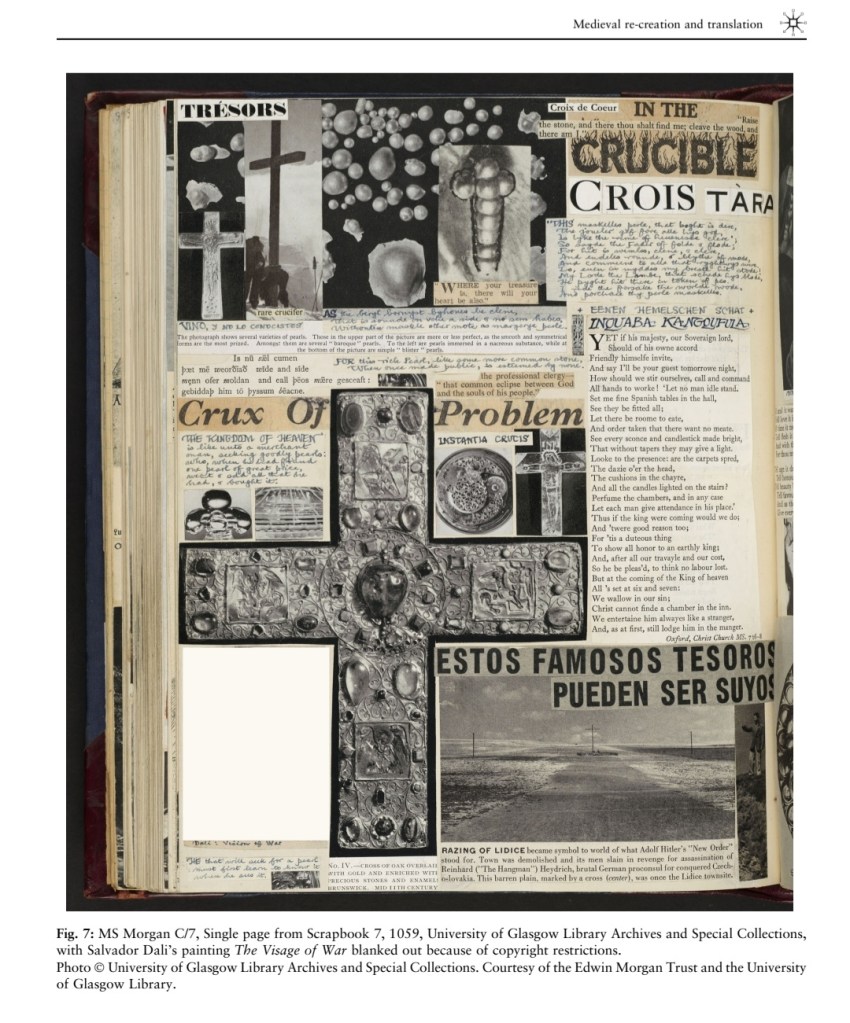
Screenshot of one of Morgan’s scrapbook pages published in the postmedieval article
The second piece I wrote was an ‘About the Cover’ text, after postmedieval‘s editors asked if they could use one of Edwin Morgan’s scrapbook page-spreads on the cover of the issue. This was a really enjoyable invitation to spend more time slowly and closely reading a single page from the vast and unruly scrapbooks (3600 pages in total). I let myself be drawn in by a single image from Scrapbook 1, a panel from the early-eighth-century Franks Casket, and wondered (in a speculative and open-ended sense) if this might be the key to unlocking the whole composition.
Morgan’s use of an image from the Casket is a knowing and playful gesture. It invites us to actively engage with the tangled material of the scrapbook page-spread. A reader of the scrapbooks forges new connections as they move around the page and through the books via different routes. There is no one way to read or unlock the scrapbook page. We should revel in its riddling multiplicity.
Huge thanks are due here to Hannah Armstrong and Rebecca Menmuir who organised a workshop on Medieval Forgeries in 2022, where I met E. K. Myerson, and then invited us all to contribute to a Forgeries Essay cluster for postmedieval journal. They have been brilliant editors and collaborators.
I haven’t stopped thinking and working with Morgan’s scrapbooks yet – last week I co-ran a workshop with Fran Allfrey and Carl Kears (as part of Revoicing Medieval Poetry) at the IONA conference at King’s College London, where I led an exercise inspired by Morgan’s techniques of scrapbooking, assemblage and collage.
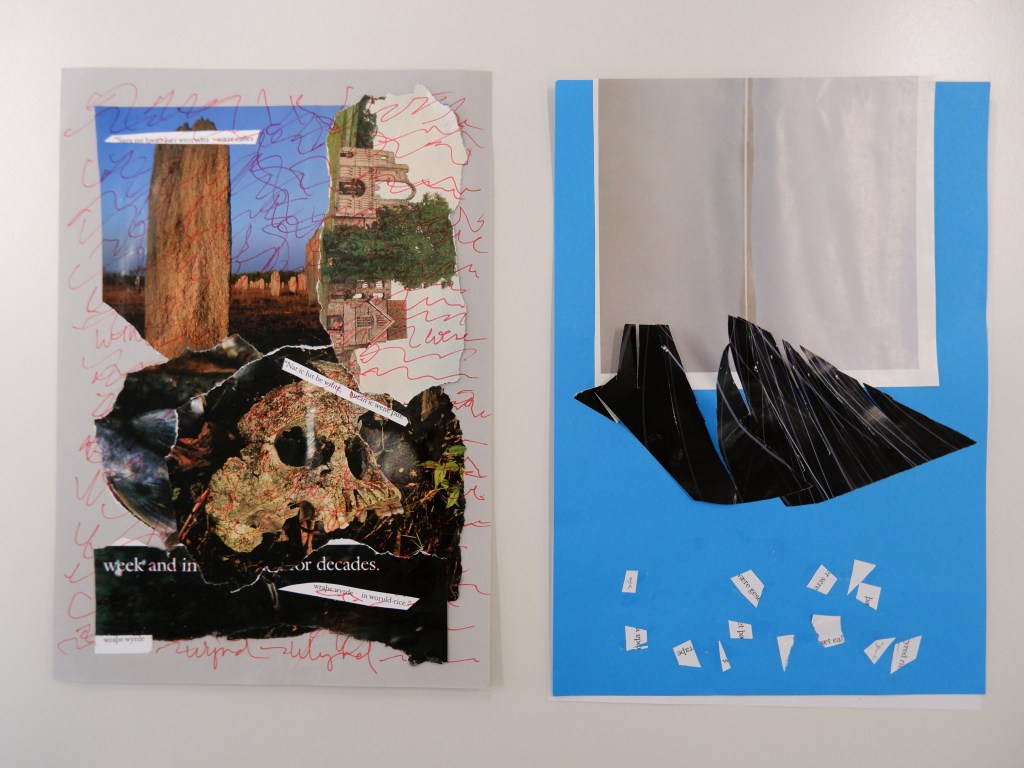
Collages in response to the Old English Pharoah poem made by Lisa Weston (left) and Heather Maring (right)
In the workshop I asked how the material/tactile/visual process of collage might allow us to explore the outer-reaches of a text we were beginning to translate from Old English into new language? How might working associatively and impulsively with found visual and verbal materials (old magazines, newspapers and books) inform the subterranean architecture of a translation? The workshop was really enjoyable, and it’s formed one of a series I’ve run this summer exploring collage poetry, cut-up text, and writing with scissors, in York, Manchester and London. I would love to run more creative workshops like this – so feel free to be in touch if you have a budget and this is of interest!
An article from my current research project has just been published Open Access with the Review of English Studies, this means that anyone can read it, even if you don’t have an institutional affiliation. The article, ‘The Haunted Island: Medieval History and the Old English Elegies in Brenda Chamberlain’s Tide-race (1962)’, explores the relationship between Brenda Chamberlain’s 1962 memoir Tide-race and medieval literature and culture on Ynys Enlli/Bardsey Island.
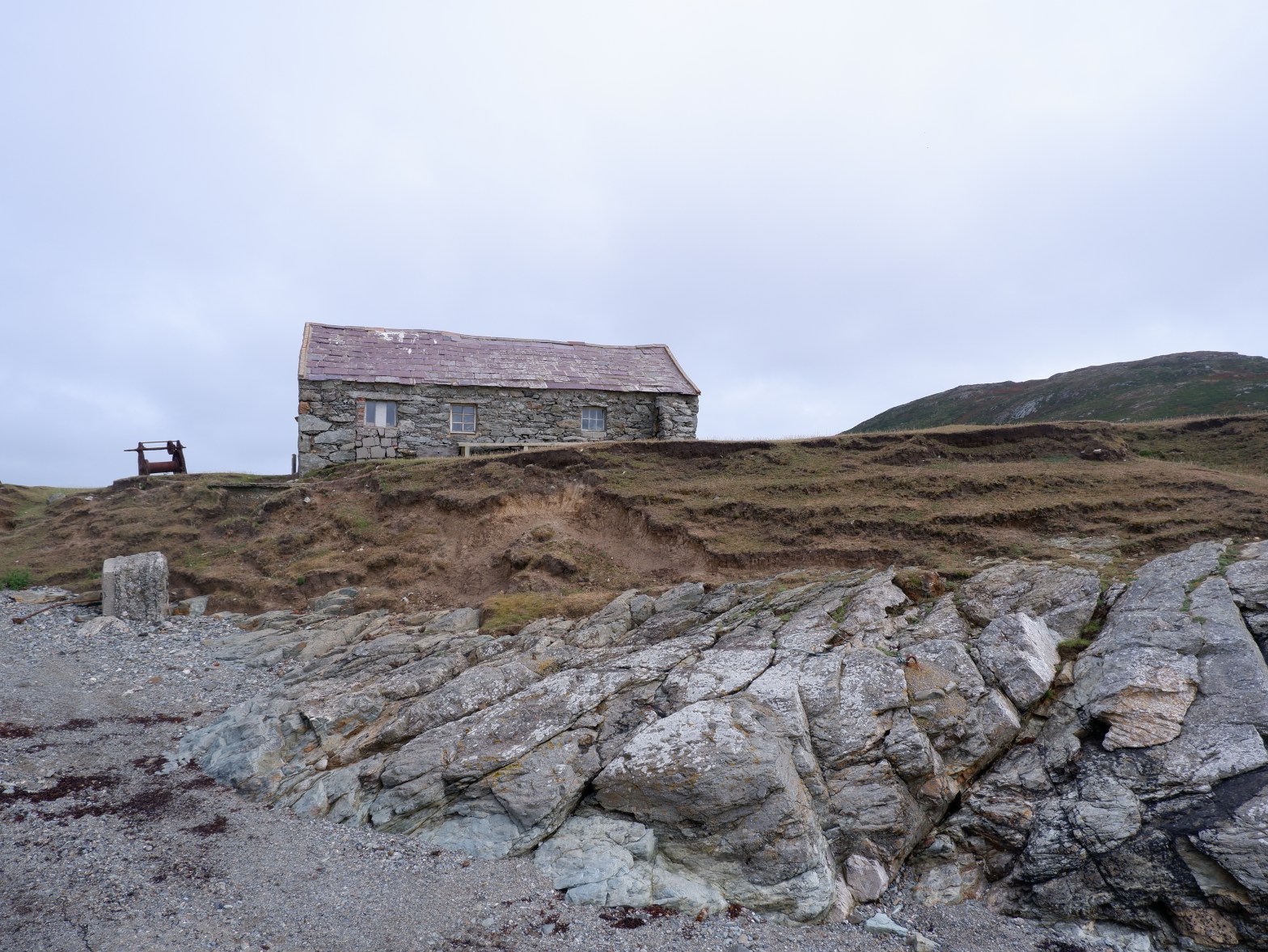
Picture of the chapel on Ynys Enlli
Brenda Chamberlain was a fascinating Welsh writer-artist who, after the Second World War and the break-up of her marriage to the artist John Petts, retreated to the remote island of Enlli, where she lived for more than a decade. There were just twelve permanent residents of this remote island at the time, and supplies of food and mail could be completely cut off by the wild currents and bad weather. When Chamberlain published her evocative, dark and surreal memoir about life there in 1962 she was subsequently asked to leave the island by her landlord Lord Newborough. The islanders felt betrayed and exposed by the portrait presented of them in Tide-race, a book which blurs the lines between fact and fiction, and draws on Chamberlain’s visual and verbal work to create a hybrid, protean work.
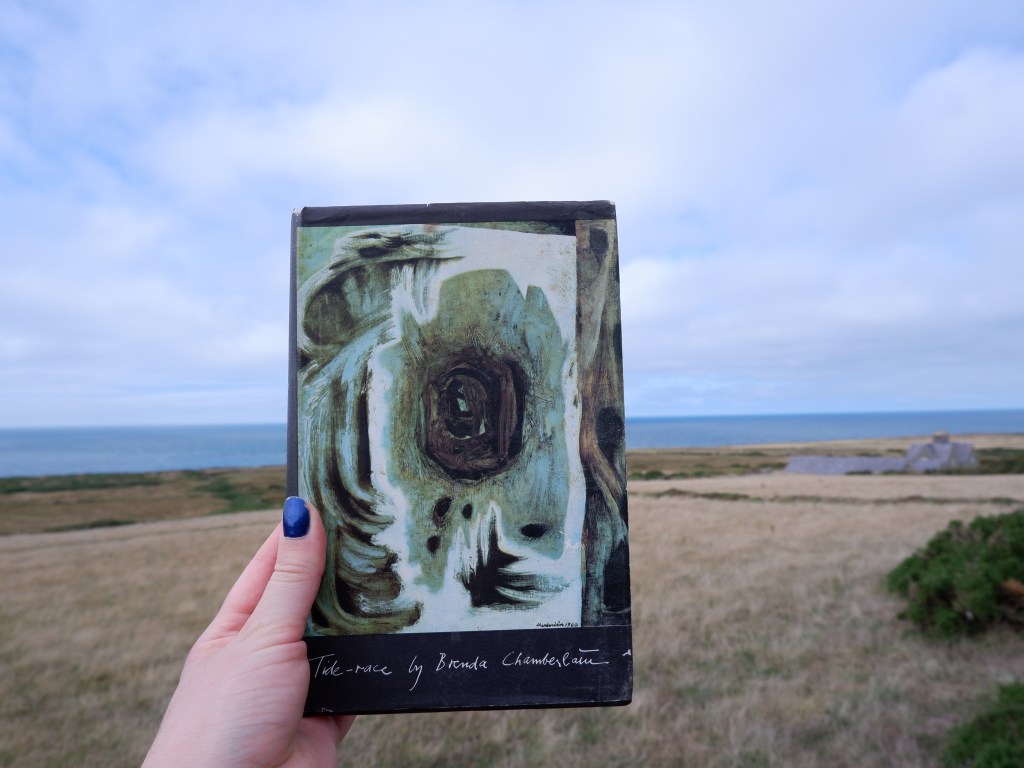
A copy of Brenda Chamberlain’s Tide-race on Ynys Enlli
In my article I reflect on the ethics of this commitment to art over community, and to creativity over connection. The main focus of my discussion though, looks at how Ynys Enlli/Bardsey Island has been constructed as a male, religious space since the early Middle Ages and the work that Chamberlain does in Tide-race to rewrite the island in a different image. In Tide-race the island’s medieval history is erased, subsumed, or submerged, and Chamberlain seeks to weave the silenced voice of the island’s women through the memoir instead. Archival research at the National Library of Wales/Llyfrgell Genedlaethol Cymru, including Chamberlain’s early typescripts for the book, notebooks with sketches and drafts, and correspondence with writers like Roland Mathias, all inform the reading I offer in this article.
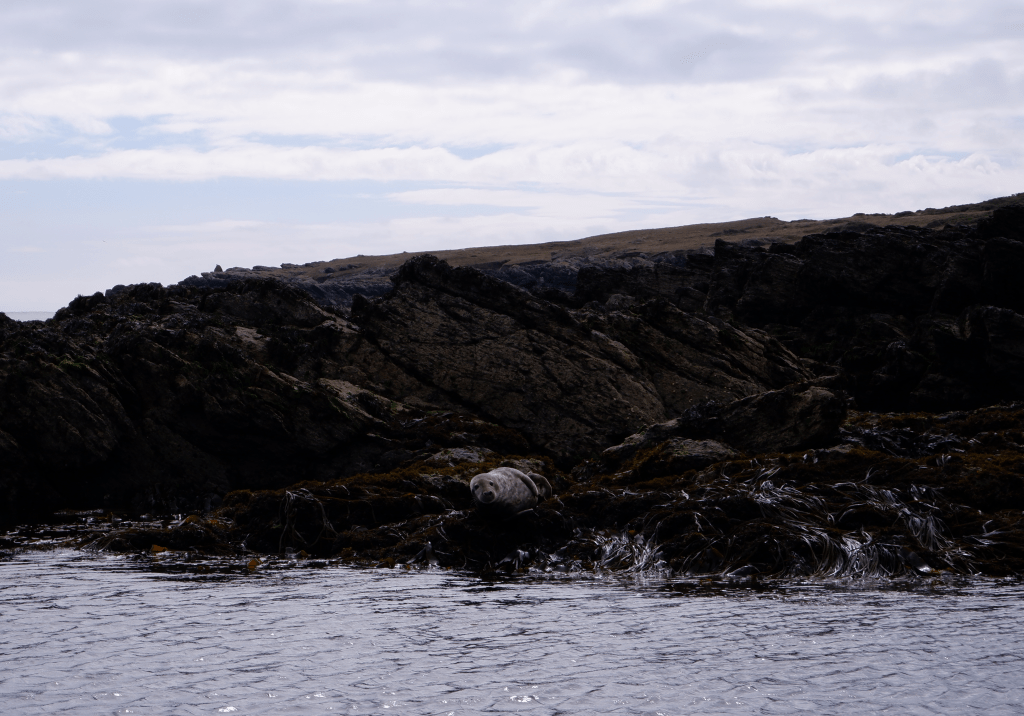
A seal on Ynys Enlli
Perhaps that’s enough to tempt you to go and have a look at the article, which puts Chamberlain’s early 1960s work of autofiction into dialogue with early medieval poems in Old English like Beowulf,The Wanderer, The Seafarer and The Wife’s Lament! If you want to know more about Ynys Enlli, or how you can visit this incredible island, I recommend taking a look at the Bardsey Island Trust’s website.
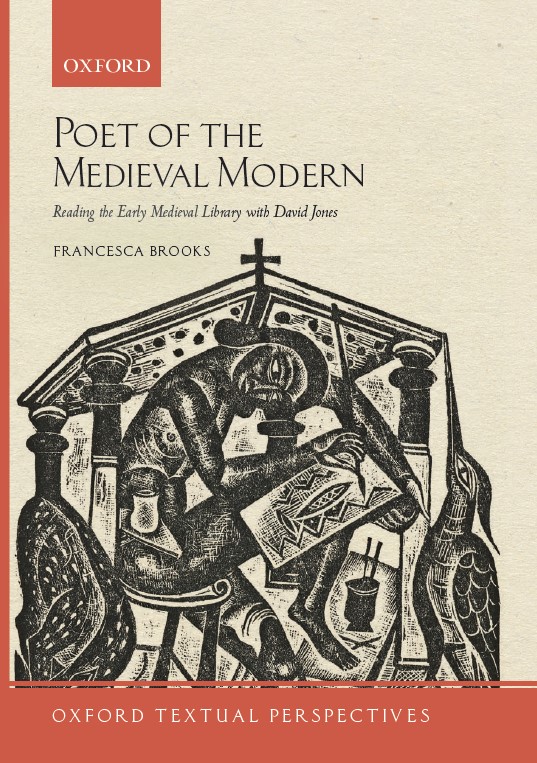
Poet of the Medieval Modern, my first monograph, has just won the University English Book Prize 2022! I’m really delighted to see the book receive this recognition and to see that the judges have understood so well what it was I wanted to achieve.
The judges write:
‘This is an exceptional book that combines a wealth and depth of scholarship with an engaging writing style that draws even the non-specialist reader in. Focussed on The Anathemata, a work published by Faber in 1952 by autodidact, artist, and poet David Jones, it demonstrates through meticulous examination of archival materials and annotations from the Anglo-Saxon Library as well as from previously unexamined correspondence, the extent to which acts of reading and creative critical thinking on Jones’s part underpinned production of The Anathemata, a culturally and linguistically composite text that uses translation as a means of cultural renewal.
It makes an original contribution to both Medieval Studies and Modernism, the former in respect of Jones’s engagement with Old English which Brooks shows to have had ‘a far greater influence … than previously recognized’ on his work, the latter in respect of the archival turn in New Modernist Studies. It combines archival research and genetic criticism with a nuanced understanding of creative process. […]
Uncovering a richly hybrid heritage that transcends national categories, this is an important book not just for modernist scholars in general but for anyone thinking about literary identity.’
You can buy the paperback for just £18.99 from any online book retailer, but if you decide to buy direct from OUP here you can use the code ‘AAFLYG6’ to get 30% off.
The first review, written by Paul Robichaud for Modern Philology, can also be read here.
I spent March in Glasgow for a Research Fellowship with the Archives and Special Collections of the University Library, long delayed from 2020 because of the pandemic. I had been dreaming of Glasgow for a long time, often through the poetry of Scots Makar and Glasgow Laureate Edwin Morgan, whose archive my fellowship research was focused on.
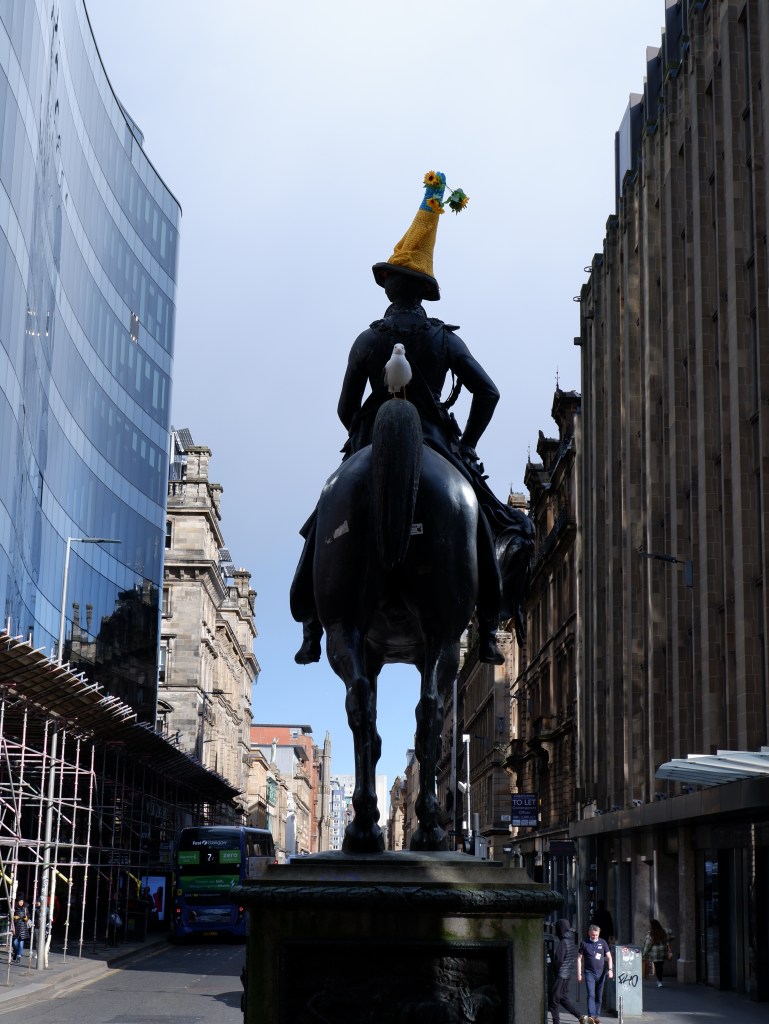
Glasgow’s iconic Duke of Wellington statue with a cone on his head, and a seagull on the horse’s rear. The cone is yarn-bombed with the colours of the Ukrainian flag.
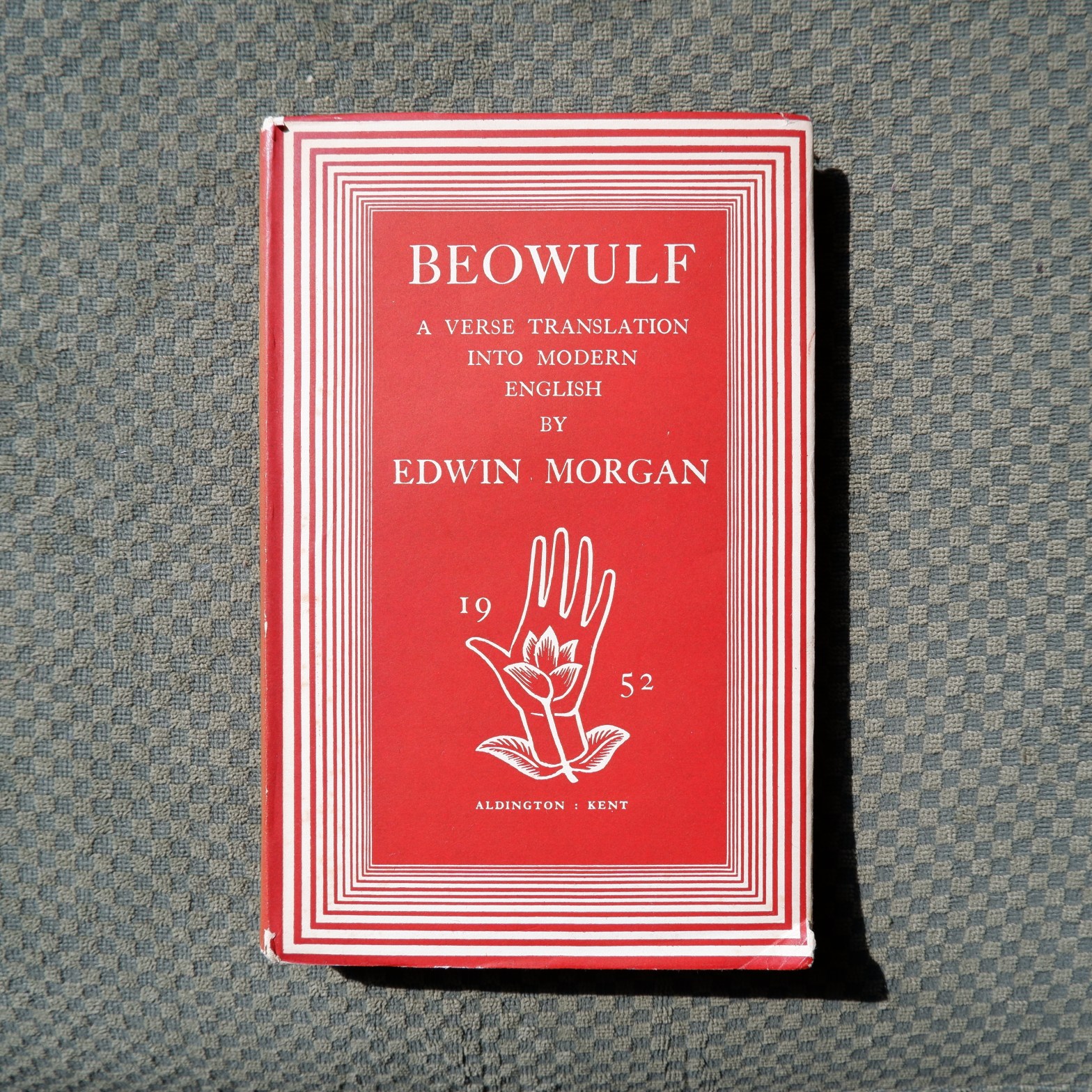
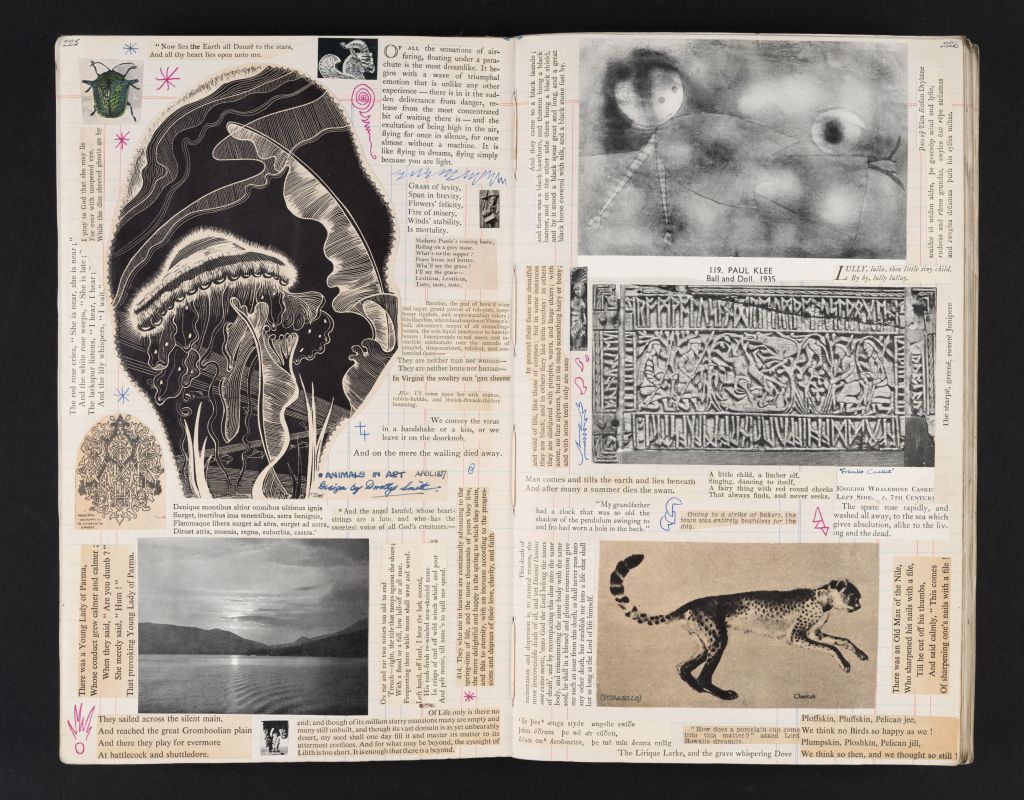
This week the Library published a blogpost that I wrote about my work with Morgan’s ‘vast, unruly and magnificent’ scrapbooks and their relationship to the early medieval poetry, such as Beowulf, that Morgan was translating in the early part of his career.
[In the scrapbooks] medieval fragments jostle for space alongside pictures of jellyfish, sea anemones and goose barnacles, photographs of blasted snow-bound mountains, or surreptitious allusions to queer desire, as well as news items about cosmic rays and potential radio transmissions intercepted from outer space.
MS Morgan C/1 p225-226 – this double-page spread shows a print of a jellyfish facing a panel from the early medieval Franks Casket
Putting together the blogpost and going back over my research notes made me realise just how much I had to say about Morgan’s scrapbooks. If Morgan’s desire for his translations of medieval texts was that ‘the nerves must sometimes tingle and the skin flush’, this had certainly been the effect on me of the visio-verbal scrapbooks and collages. Perhaps I will try and find another venue to write about the inspiration my research with Morgan provided for my own evening collage sessions in Glasgow.
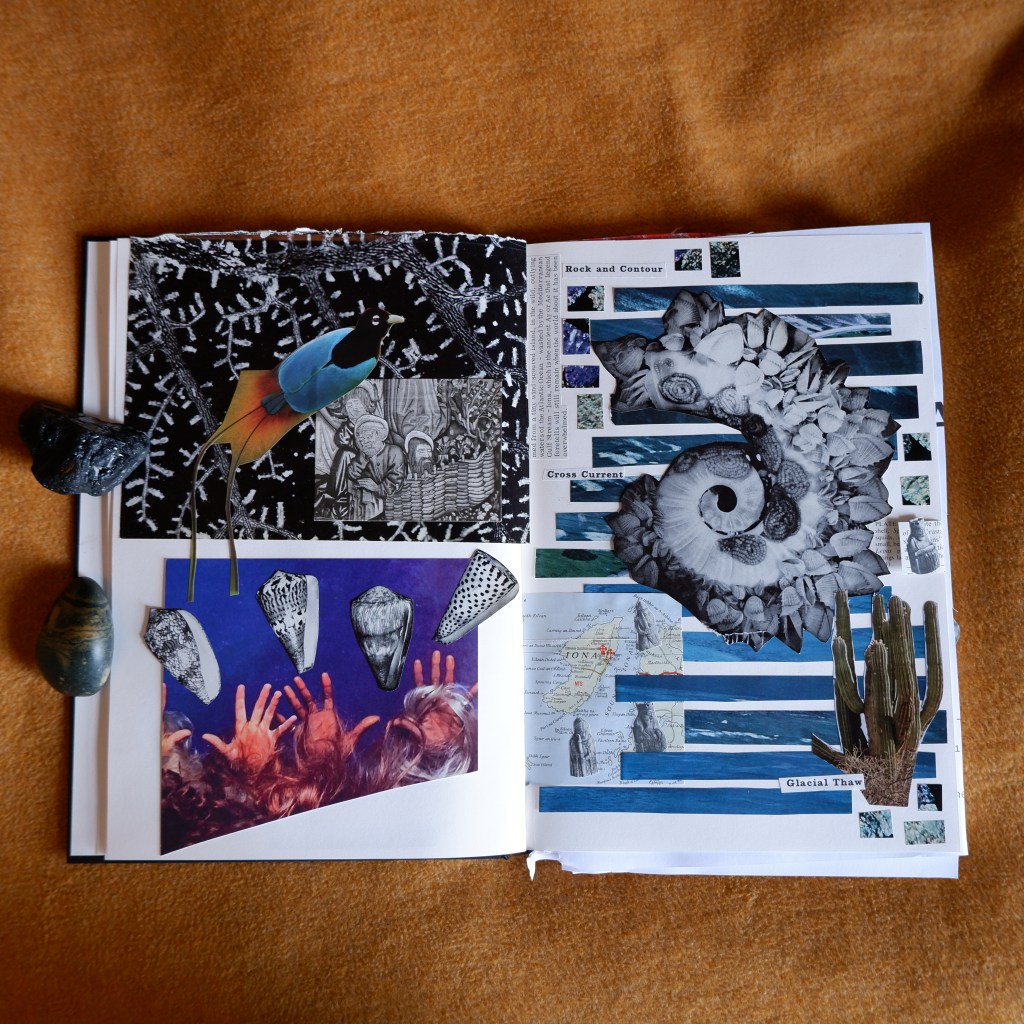
One of the collages I produced while staying in Glasgow and working with the archive.


 Francesca Brooks