A Quest for the Camaldolese Grail in the Footsteps of Lynette Roberts

I have a longish essay in the current issue of PN Review (295), ‘A Quest for the Camaldolese Grail in the Footsteps of Lynette Roberts’. It’s the first thing I’ve had published about the Argentine-born, Welsh writer Lynette Roberts (1909-95), who is one of the subjects of my current research project on ‘Haunted Archives’ and women rewriting the medieval past. The essay is about access to cultural heritage, impostor syndrome, material and sensorial encounters with medieval manuscripts, and the fascinating writing life of Roberts herself.
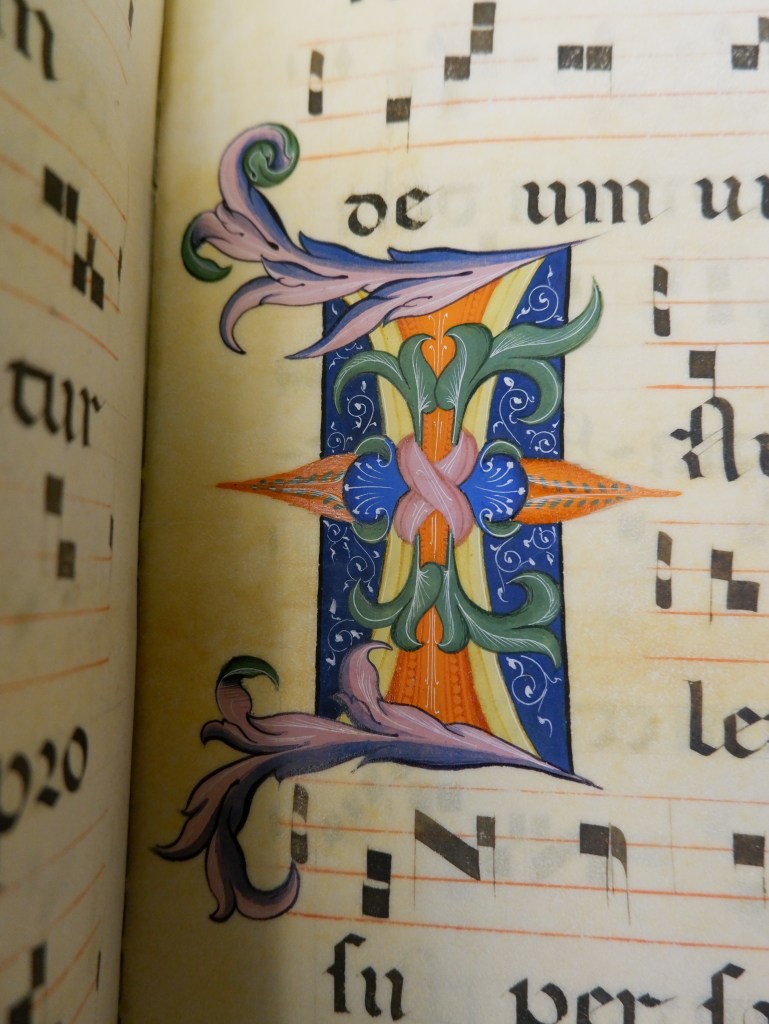
An illuminated rubric in the Camaldolese Grail

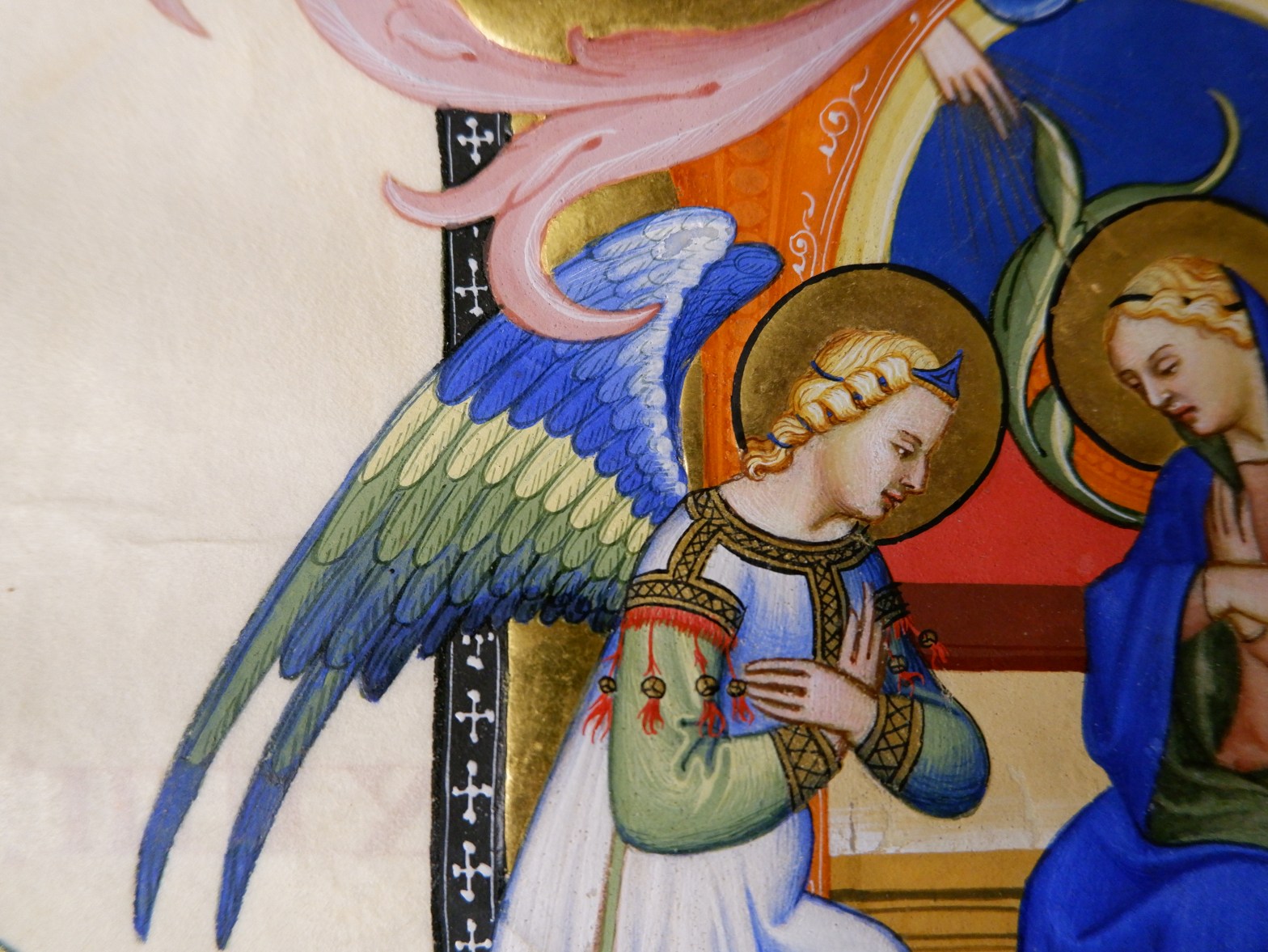
I thought I would share a brief post here with some images of the Camaldolese Grail (the subject of my quest and of Roberts’ parallel quest in the 1940s), as the piece is unillustrated in PN Review. The Camaldolese Grail (or Gradual) is a stunning illuminated fourteenth-century manuscript from Italy, now held by the Victoria And Albert Museum Art Library. I went to see it after reading Roberts’ essay on the manuscript (published in the 1940s in a journal known as Life & Letters) and took great pleasure in spending time with this gorgeous, gilded object.
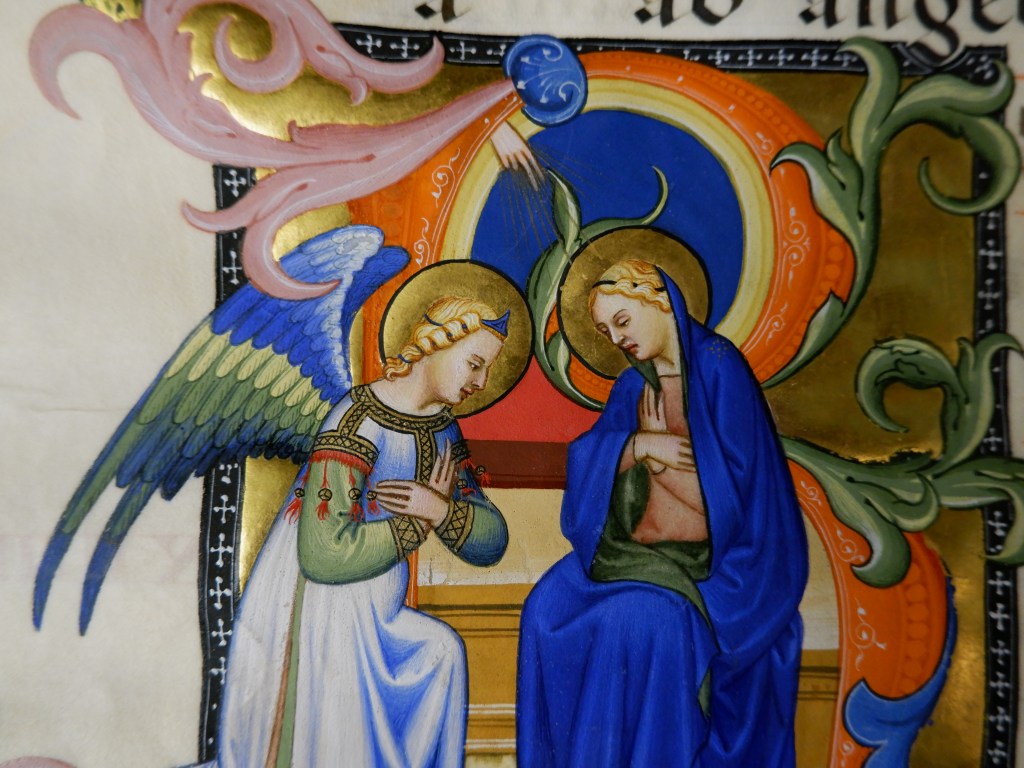
Detail from one of the illuminations in the Camaldolese Grail

Here’s a little snippet from the essay, demonstrating why Roberts’ essay had filled me with such curiosity:

‘Roberts writes about mushroom shades and mole tones and pink blancmange rocks. She draws our attention to the lines on a lake which do not depict ice, although she might forgive us for thinking so, but as she describes them appear to curve ‘like bleached seaweed, oriental eyelashes, or flayed wheat’. Arguing for why she thinks we see Lorenzo Monaco’s hand in this ostentatious, gilded manuscript, she writes that ‘[t]he miniatures which I have studied have the same pink blanc-mange rocks, the dark polished trees, lined haloes, heavy eye-shadow, and drooping mouths terminating in small dots’ of the paintings she has observed in the National Gallery. Roberts doesn’t simply describe the manuscript. She uses her poet’s eye to vividly evoke her aesthetic and material encounter with this sacred object, producing a surreal portrait of a book that seems to distort time under her gaze.’
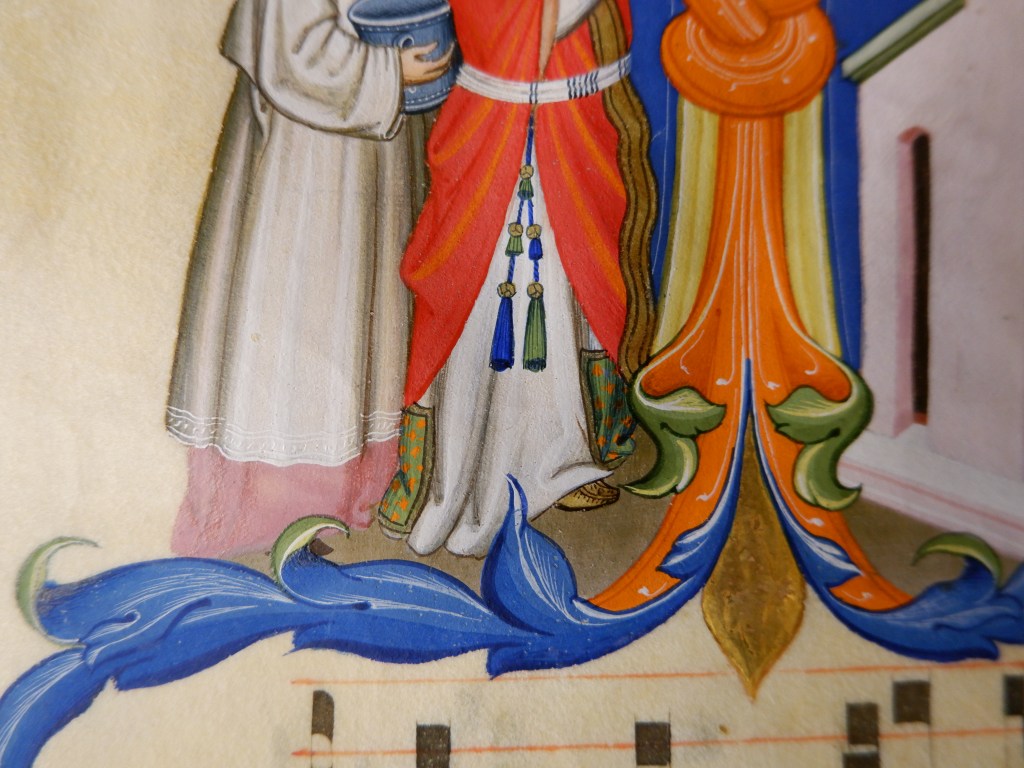
Another detail from the illuminations in the Camaldolese Grail

My visit to the Art Library didn’t go perfectly smoothly, however, and it was this experience of fear, trepidation, and even shame, as well as what this revealed about the significance of Roberts’s own encounter with the manuscript, that became the focus of the essay. I don’t want to repeat the story here (you’ll have to buy a copy of the journal), but what I initially ordered in the library wasn’t the manuscript at all – it was an itemised collection of waste materials from the manuscript’s restoration in 2009!

A small glass bottle containing some waste from the manuscript’s restoration

If you’ve never heard of Lynette Roberts before, and haven’t read any of her poetry, then you’re in for a treat, as Carcanet are publishing a new and expanded edition of her poems next month.
Creative Re-creation and Translation: Edwin Morgan, Derek Jarman & the archive

Last month, ahead of the launch of issue 15.2, two pieces I wrote or co-wrote were published with postmedieval: a journal of medieval culture studies. Both gave me the opportunity to write and think more about Edwin Morgan’s scrapbooks in the University of Glasgow Archives, and to reflect on how my month spent with them in 2022 has continued to shape my creative and critical practice.

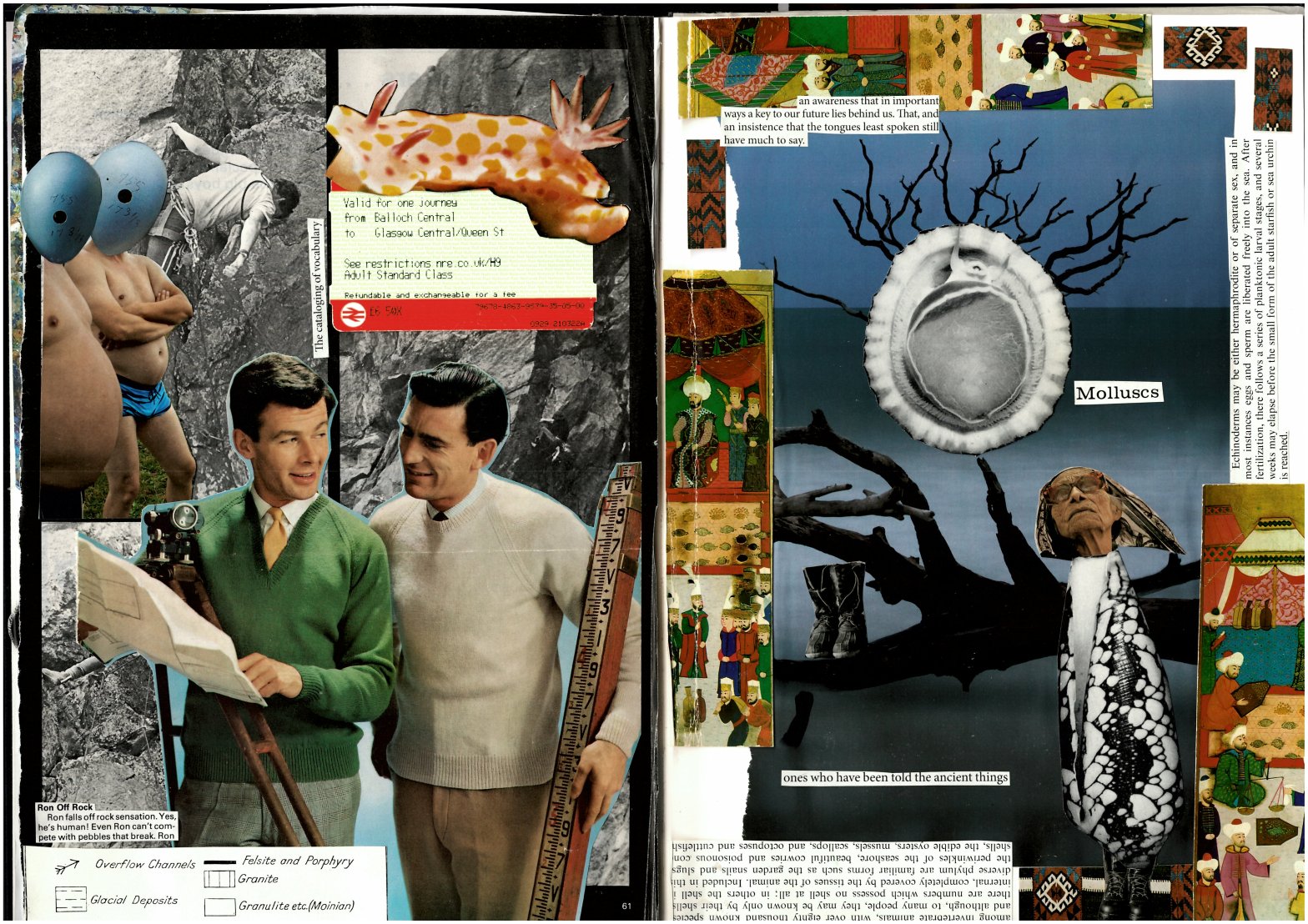
For the first piece, ‘Medieval re-creation and translation in the archives of Derek Jarman and Edwin Morgan: A Dialogue’, I spent several months corresponding with the artist and writer E. K. Myerson over email in a kind of ‘show and tell’. As our creative-critical conversation unfolded in 2023, we discussed the queer medievalisms of Edwin Morgan and Derek Jarman, and reflected on what it means to be a medievalist working in a modern archive where we might feel more intimately connected with the touch and desires of the subjects of our research. In the second half of our conversation we shared how we had each responded creatively to our encounter with the archive: I, by making a Glasgow scrapbook of collage pages and page-spreads, and Myerson by working on a Jarmanesque film called ‘A submerged reliquary of a Kentish saint’.

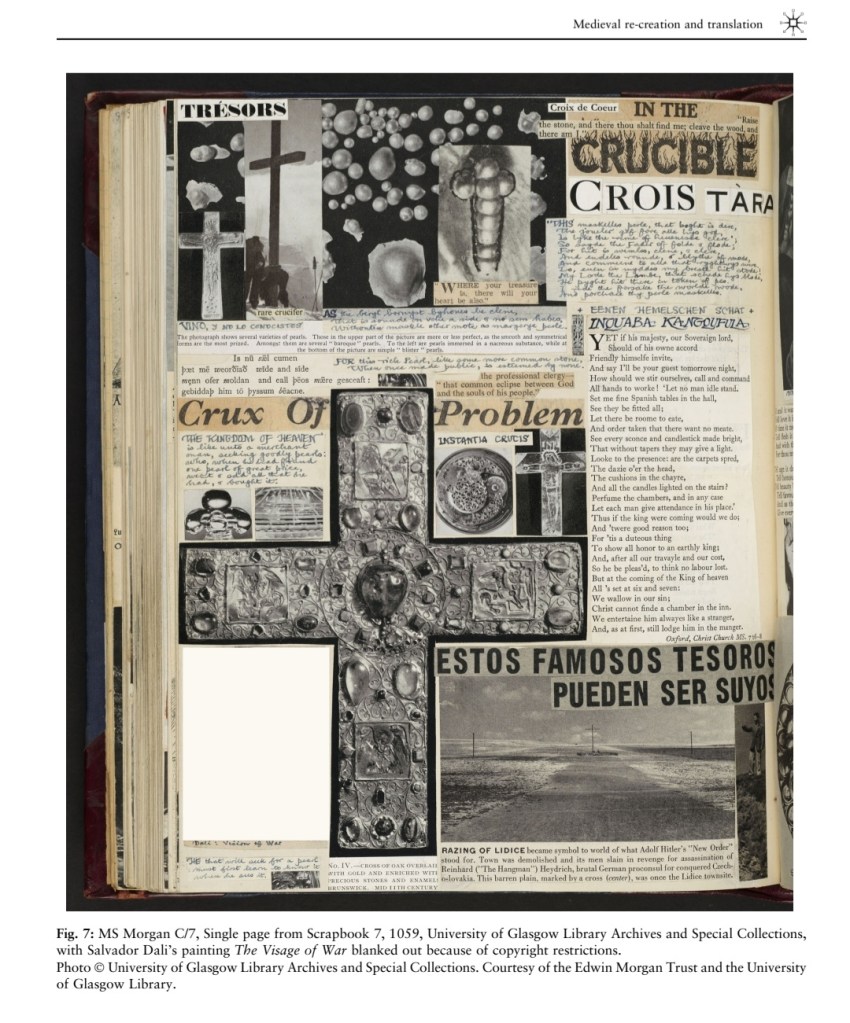
Screenshot of one of Morgan’s scrapbook pages published in the postmedieval article

The second piece I wrote was an ‘About the Cover’ text, after postmedieval‘s editors asked if they could use one of Edwin Morgan’s scrapbook page-spreads on the cover of the issue. This was a really enjoyable invitation to spend more time slowly and closely reading a single page from the vast and unruly scrapbooks (3600 pages in total). I let myself be drawn in by a single image from Scrapbook 1, a panel from the early-eighth-century Franks Casket, and wondered (in a speculative and open-ended sense) if this might be the key to unlocking the whole composition.

Morgan’s use of an image from the Casket is a knowing and playful gesture. It invites us to actively engage with the tangled material of the scrapbook page-spread. A reader of the scrapbooks forges new connections as they move around the page and through the books via different routes. There is no one way to read or unlock the scrapbook page. We should revel in its riddling multiplicity.

Huge thanks are due here to Hannah Armstrong and Rebecca Menmuir who organised a workshop on Medieval Forgeries in 2022, where I met E. K. Myerson, and then invited us all to contribute to a Forgeries Essay cluster for postmedieval journal. They have been brilliant editors and collaborators.

I haven’t stopped thinking and working with Morgan’s scrapbooks yet – last week I co-ran a workshop with Fran Allfrey and Carl Kears (as part of Revoicing Medieval Poetry) at the IONA conference at King’s College London, where I led an exercise inspired by Morgan’s techniques of scrapbooking, assemblage and collage.

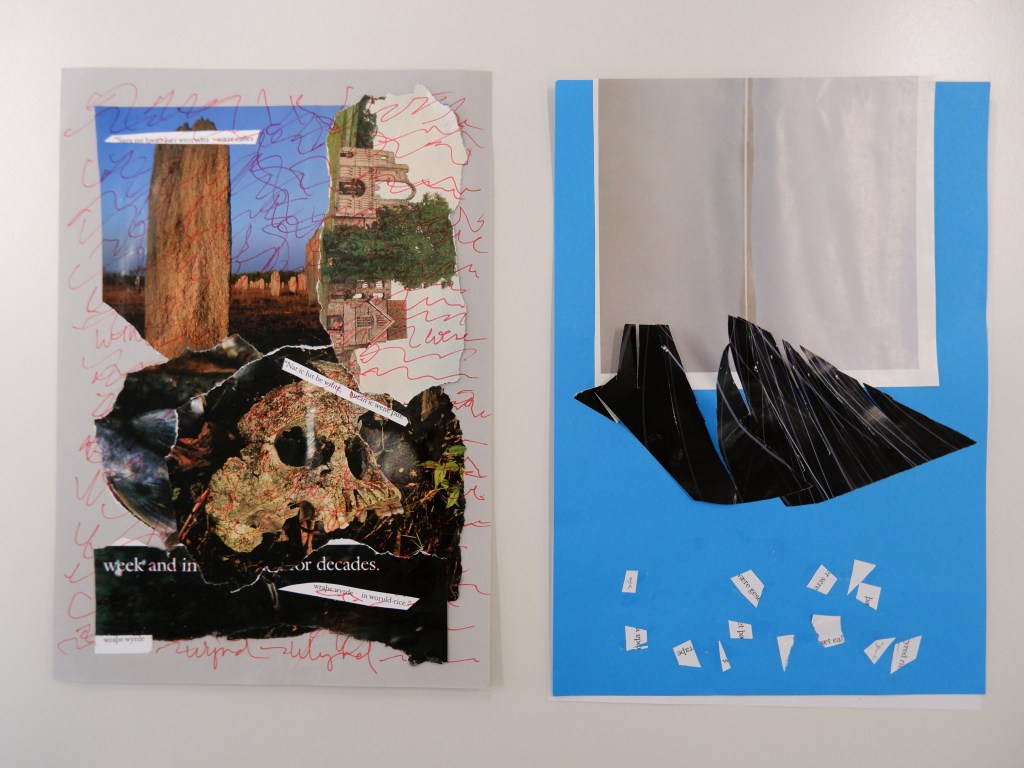
Collages in response to the Old English Pharoah poem made by Lisa Weston (left) and Heather Maring (right)

In the workshop I asked how the material/tactile/visual process of collage might allow us to explore the outer-reaches of a text we were beginning to translate from Old English into new language? How might working associatively and impulsively with found visual and verbal materials (old magazines, newspapers and books) inform the subterranean architecture of a translation? The workshop was really enjoyable, and it’s formed one of a series I’ve run this summer exploring collage poetry, cut-up text, and writing with scissors, in York, Manchester and London. I would love to run more creative workshops like this – so feel free to be in touch if you have a budget and this is of interest!

Poet of the Medieval Modern: Winner of the University English Book Prize

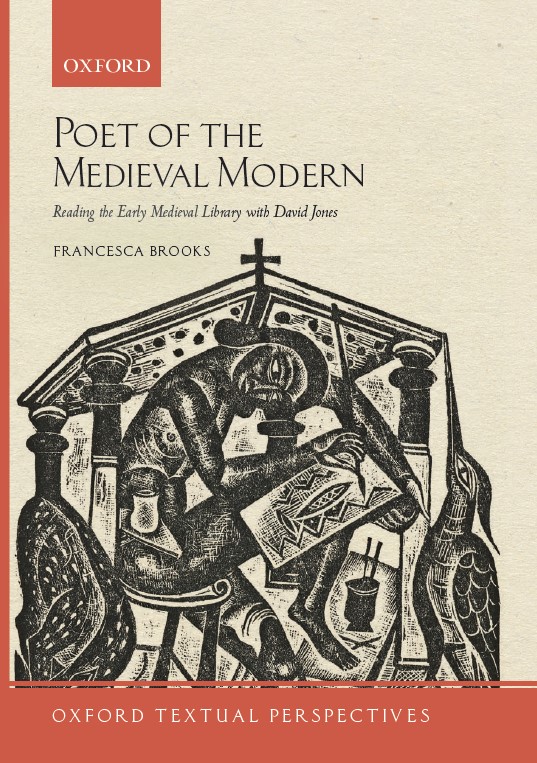
Poet of the Medieval Modern, my first monograph, has just won the University English Book Prize 2022! I’m really delighted to see the book receive this recognition and to see that the judges have understood so well what it was I wanted to achieve.

The judges write:

‘This is an exceptional book that combines a wealth and depth of scholarship with an engaging writing style that draws even the non-specialist reader in. Focussed on The Anathemata, a work published by Faber in 1952 by autodidact, artist, and poet David Jones, it demonstrates through meticulous examination of archival materials and annotations from the Anglo-Saxon Library as well as from previously unexamined correspondence, the extent to which acts of reading and creative critical thinking on Jones’s part underpinned production of The Anathemata, a culturally and linguistically composite text that uses translation as a means of cultural renewal.

It makes an original contribution to both Medieval Studies and Modernism, the former in respect of Jones’s engagement with Old English which Brooks shows to have had ‘a far greater influence … than previously recognized’ on his work, the latter in respect of the archival turn in New Modernist Studies. It combines archival research and genetic criticism with a nuanced understanding of creative process. […]

Uncovering a richly hybrid heritage that transcends national categories, this is an important book not just for modernist scholars in general but for anyone thinking about literary  identity.’

You can buy the paperback for just £18.99 from any online book retailer, but if you decide to buy direct from OUP here you can use the code ‘AAFLYG6’ to get 30% off.

The first review, written by Paul Robichaud for Modern Philology, can also be read here.